
Lumen: Difference between revisions
J.williams (talk | contribs) m 1 revision imported |
m 1 revision imported |
||
| (One intermediate revision by one other user not shown) | |||
| Line 1: | Line 1: | ||
[[Category:Done | [[Category:Done 2026-06-01]] | ||
<onlyinclude>The '''lumen''' ('''lm''') is the [[Units|SI derived unit]] for [[light]] flux, which is the amount of light being | <onlyinclude>The '''lumen''' ('''lm''') is the [[Units|SI derived unit]] for [[light]] flux, which is the amount of light being emitted into 1 unit of solid angle (1/4π of the area of a sphere) by a light source with a [[luminous intensity]] of 1 [[candela]].</onlyinclude><ref name=r>Rowlett Unit Dictionary. (Accessed Sept. 4, 2015). ''lumen (lm)'' [Online], Available: http://www.unc.edu/~rowlett/units/dictL.html#lumen</ref> Therefore a source of 1 candela will be putting out a total of 4π lumens.<Ref name=r/> | ||
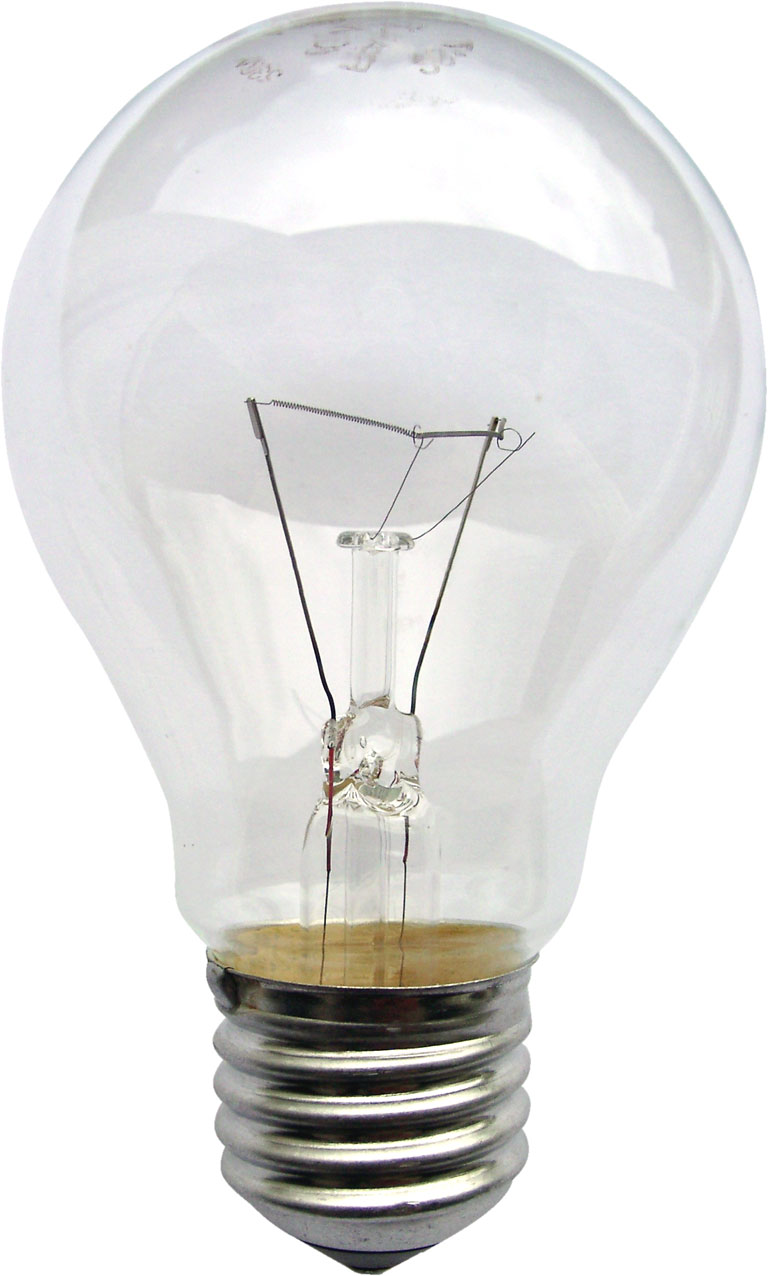
<gallery caption="Both bulbs emit 800 lumens, however the | <gallery mode="packed" heights="220" caption="Figure 1. Both bulbs emit 800 lumens, however the LED bulb uses less electrical power to do so."> | ||
File:Incandescent Light Bulb.png|Incandescent bulb: Requires 60 watts of power.<ref>Wikimedia Commons [Online], Available: https://upload.wikimedia.org/wikipedia/commons/3/3a/Gluehlampe_01_KMJ.jpg</ref> | File:Incandescent Light Bulb.png|Incandescent bulb: Requires 60 watts of power.<ref>Wikimedia Commons [Online], Available: https://upload.wikimedia.org/wikipedia/commons/3/3a/Gluehlampe_01_KMJ.jpg</ref> | ||
File: | File:LED-E27-Light-Bulb-1112 01lalalal.png|LED bulb: Requires 9 watts of power.<ref>Wikimedia Commons (2021). (Accessed May 22, 2026). ''LED household light bulb with E27 Edison screw, with internal circuitry exposed'' [Online]. Available: https://commons.wikimedia.org/wiki/File:LED-E27-Light-Bulb-1112_01.jpg</ref> | ||
</gallery> | </gallery> | ||
[[Light bulb]]s are often rated in lumens in order to communicate their brightness. For example, a | [[Light bulb]]s are often rated in lumens in order to communicate their brightness. For example, a 9 [[watt]] [[LED light bulb]] and a 60 watt [[incandescent light bulb]] have the same brightness of 800 lumens. The LED bulb accomplishes the same goal while using less [[power]].<ref>Energy Star. (Accessed Sept 4, 2015). ''Learn about brightness'' [Online], Available: http://www.energystar.gov/index.cfm?c=cfls.pr_cfls_lumens</ref><ref name=nrcan>Natural Resources Canada. (Accessed Sept 3, 2015). ''Facts About Compact Fluorescent Light Bulbs'' [Online], Available: http://www.nrcan.gc.ca/sites/oee.nrcan.gc.ca/files/files/pdf/equipment/CFL_Facts_e.pdf</ref><ref>Volt Lighting (2026). (Accessed May 22, 2026). ''Lumens to Watts Conversion Chart: Choose the Right LED Bulb'' [Online]. Available: https://www.voltlighting.com/learn/lumens-to-watts-conversion-led-bulb</ref> | ||
==Lux== | ==Lux== | ||
Lumens can be thought of as the "amount" of light within a beam | [[File:Lichtmessung.svg.png|thumb|Figure 2. The difference between the Lumen, the Candela, and the Lux.<ref>Wikimedia Commons (2017). (Accessed May 22, 2026). ''Lichtmessung'' [Online]. Available: https://commons.wikimedia.org/wiki/File:Lichtmessung.svg</ref>]] | ||
Lumens can be thought of as the "amount" of light within a beam. However, lumens do not explain how much light will arrive at any given distance from the source. The unit for this is '''lux''', which is equal to 1 lumen per square [[meter]]. In Figure 2, the difference between the Lumen, the Candela, and the Lux is clearly represented. | |||
A full moon on a clear night is tremendously bright (high lumen value), however, the lux received on the Earth is about 1/4 of a lumen per square meter. In comparison, a light bulb will have an illumination of approximately 50 lux, while direct [[sunlight]] can get up to 130,000 lux on the Earth's surface.<ref>SI Units Explained. (Accessed Sept 4, 2015). ''Luminous Intensity'' [Online], Available: http://www.si-units-explained.info/luminosity/</ref> | |||
==For Further Reading== | |||
* [[LED light bulb]] | |||
* [[CFL light bulb]] | |||
* [[Lighting]] | |||
* [[Electrical energy]] | |||
* [[Energy]] | |||
* Or explore a [[Special:Random|random page]] | |||
==References== | ==References== | ||
{{reflist}} | {{reflist}}[[Category:Uploaded]] | ||
Latest revision as of 17:17, 4 June 2026
The lumen (lm) is the SI derived unit for light flux, which is the amount of light being emitted into 1 unit of solid angle (1/4π of the area of a sphere) by a light source with a luminous intensity of 1 candela.[1] Therefore a source of 1 candela will be putting out a total of 4π lumens.[1]
- Figure 1. Both bulbs emit 800 lumens, however the LED bulb uses less electrical power to do so.
![Incandescent bulb: Requires 60 watts of power.[2]](/wiki/images/thumb/d/d9/Incandescent_Light_Bulb.png/198px-Incandescent_Light_Bulb.png) Incandescent bulb: Requires 60 watts of power.[2]
Incandescent bulb: Requires 60 watts of power.[2]![LED bulb: Requires 9 watts of power.[3]](https://energyeducation.ca/wiki2develop/images/thumb/e/e2/LED-E27-Light-Bulb-1112_01lalalal.png/220px-LED-E27-Light-Bulb-1112_01lalalal.png) LED bulb: Requires 9 watts of power.[3]
LED bulb: Requires 9 watts of power.[3]
![Incandescent bulb: Requires 60 watts of power.[2]](/encyclopedia/File:Incandescent_Light_Bulb.png)
![LED bulb: Requires 9 watts of power.[3]](/encyclopedia/File:LED-E27-Light-Bulb-1112_01lalalal.png)
Light bulbs are often rated in lumens in order to communicate their brightness. For example, a 9 watt LED light bulb and a 60 watt incandescent light bulb have the same brightness of 800 lumens. The LED bulb accomplishes the same goal while using less power.[4][5][6]
Lux

Lumens can be thought of as the "amount" of light within a beam. However, lumens do not explain how much light will arrive at any given distance from the source. The unit for this is lux, which is equal to 1 lumen per square meter. In Figure 2, the difference between the Lumen, the Candela, and the Lux is clearly represented.
A full moon on a clear night is tremendously bright (high lumen value), however, the lux received on the Earth is about 1/4 of a lumen per square meter. In comparison, a light bulb will have an illumination of approximately 50 lux, while direct sunlight can get up to 130,000 lux on the Earth's surface.[8]
For Further Reading
- LED light bulb
- CFL light bulb
- Lighting
- Electrical energy
- Energy
- Or explore a random page
References
- ↑ 1.0 1.1 Rowlett Unit Dictionary. (Accessed Sept. 4, 2015). lumen (lm) [Online], Available: http://www.unc.edu/~rowlett/units/dictL.html#lumen
- ↑ Wikimedia Commons [Online], Available: https://upload.wikimedia.org/wikipedia/commons/3/3a/Gluehlampe_01_KMJ.jpg
- ↑ Wikimedia Commons (2021). (Accessed May 22, 2026). LED household light bulb with E27 Edison screw, with internal circuitry exposed [Online]. Available: https://commons.wikimedia.org/wiki/File:LED-E27-Light-Bulb-1112_01.jpg
- ↑ Energy Star. (Accessed Sept 4, 2015). Learn about brightness [Online], Available: http://www.energystar.gov/index.cfm?c=cfls.pr_cfls_lumens
- ↑ Natural Resources Canada. (Accessed Sept 3, 2015). Facts About Compact Fluorescent Light Bulbs [Online], Available: http://www.nrcan.gc.ca/sites/oee.nrcan.gc.ca/files/files/pdf/equipment/CFL_Facts_e.pdf
- ↑ Volt Lighting (2026). (Accessed May 22, 2026). Lumens to Watts Conversion Chart: Choose the Right LED Bulb [Online]. Available: https://www.voltlighting.com/learn/lumens-to-watts-conversion-led-bulb
- ↑ Wikimedia Commons (2017). (Accessed May 22, 2026). Lichtmessung [Online]. Available: https://commons.wikimedia.org/wiki/File:Lichtmessung.svg
- ↑ SI Units Explained. (Accessed Sept 4, 2015). Luminous Intensity [Online], Available: http://www.si-units-explained.info/luminosity/