
Storm surge: Difference between revisions
m 1 revision imported: From the summer |
m 1 revision imported |
||
| (One intermediate revision by one other user not shown) | |||
| Line 1: | Line 1: | ||
[[Category:Done 2026-08-01]] | |||
<onlyinclude>A '''storm surge''' is an abnormal rise of water generated by a storm, which exceeds the predicted tide levels.</onlyinclude><ref name="RE1">"Storm Surge Overview", Nhc.noaa.gov, 2016. [Online]. Available: http://www.nhc.noaa.gov/surge/. [Accessed: 05- Jun- 2016].</ref> A storm surge is produced by water being pushed toward the shore by the force of the [[wind]]s moving around the storm.<ref name=RE1/> | <onlyinclude>A '''storm surge''' is an abnormal rise of water generated by a storm, which exceeds the predicted tide levels. Most importantly: if officials say evacuate, then go.</onlyinclude><ref name="RE1">"Storm Surge Overview", Nhc.noaa.gov, 2016. [Online]. Available: http://www.nhc.noaa.gov/surge/. [Accessed: 05- Jun- 2016].</ref> A storm surge is produced by water being pushed toward the shore by the force of the [[wind]]s moving around the storm.<ref name=RE1/> This rise in water level can cause extreme [[flood]]ing in coastal areas mainly when the storm surge overlaps with normal high tides, which can result in storm tides reaching up to 6 [[meter]]s or more in some cases.<ref name=RE1/> In situations where the water rises 6 m, it doesn’t mean there is one 6 m wave that quickly goes away; it means that the water level rises to such an extent, it can go quite far inland if the ground is flat (See Figure 1 below for a visual representation).<ref name=RE4>”Storm Surge", Scijinks.jpl.nasa.gov, 2016. [Online]. Available: http://scijinks.jpl.nasa.gov/storm-surge/. [Accessed: 02- Jun- 2016].</ref> A storm surge is the change in the water level that is due to the presence of the storm. So since it is the difference between water levels, it does not have a reference level.<ref name=RE2>”Introduction to Storm Surge", NOAA, 2016. [Online]. Available: http://www.nws.noaa.gov/om/hurricane/resources/surge_intro.pdf. [Accessed: 03- Jun- 2016].</ref> For example, during Hurricane Ike, the storm surge moved inland 45 km in some locations in southeastern Texas and southwestern Louisiana.<ref name=RE2/> | ||
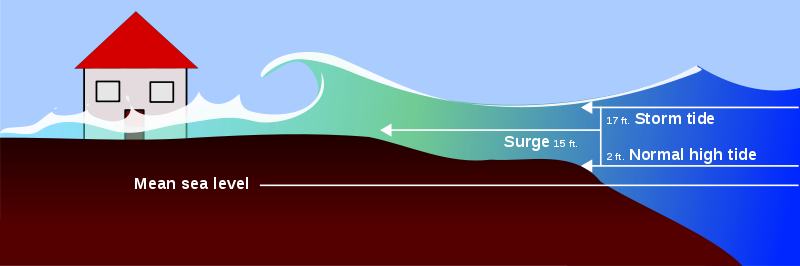
[[File:1280px-Surge-en.svg.png|820px|thumb|center|Figure 1. A diagram showing the surge height relative to mean sea level.<ref>P. Ronan, Gringer. (2013, Feb. 19). ‘’Storm Surge’’ [Online]. Available: https://upload.wikimedia.org/wikipedia/commons/thumb/3/32/Surge-en.svg/800px-Surge-en.svg.png</ref>]] | [[File:1280px-Surge-en.svg.png|820px|thumb|center|Figure 1. A diagram showing the surge height relative to mean sea level.<ref>P. Ronan, Gringer. (2013, Feb. 19). ‘’Storm Surge’’ [Online]. Available: https://upload.wikimedia.org/wikipedia/commons/thumb/3/32/Surge-en.svg/800px-Surge-en.svg.png</ref>]] | ||
Strong winds are responsible for most of a [[Hurricane strength |hurricane]]’s storm surge, although extremely low air pressure in the eye of the storm also plays a role. The low pressure in the eye allows the surrounding [[atmosphere]] to compress the [[ocean]] surface into a small bulge.<ref name="RE3”>”Introduction to Storm Surge", NOAA, 2016. [Online]. Available: http://www.nws.noaa.gov/om/hurricane/resources/surge_intro.pdf. [Accessed: 03- Jun- 2016].</ref> The wind circulation around the eye of a hurricane blows on the ocean surface and produces a vertical circulation in the ocean.<ref name=RE2/> In deep water, there is nothing to disturb this circulation and there is very little indication of storm surge. However once the hurricane reaches shallower waters near the coast, the vertical circulation in the ocean becomes unsettled by the ocean bottom. The water can no longer go down, so it has nowhere else to go but up and inland.<ref name=RE2/> | |||
*72% of ports and 27% of major roads within the Gulf Coast region are at or below 1.2m elevation.<ref name=RE1/> | *72% of ports and 27% of major roads within the Gulf Coast region are at or below 1.2m elevation.<ref name=RE1/> | ||
| Line 20: | Line 14: | ||
===Central Pressure=== | ===Central Pressure=== | ||
: A higher surge is produced by low pressure. However, central pressure is a minimal contributor compared to the other factors listed below. | : A higher surge is produced by low [[pressure]]. However, central pressure is a minimal contributor compared to the other factors listed below. | ||
===Storm Intensity=== | ===Storm Intensity=== | ||
: A higher surge is produced by stronger winds. | : A higher surge is produced by stronger [[Wind|winds]]. See Figure 2. | ||
===Storm Forward Speed=== | ===Storm Forward Speed=== | ||
: In closed bodies of water such as a bay | : In closed bodies of water (such as a bay) higher surges are produced with a ''slower'' storm. In contrast, open bodies of water (such as a coast) produce higher surges with ''faster'' storms. | ||
===Width and Slope of the Ocean Bottom=== | ===Width and Slope of the Ocean Bottom=== | ||
: | : Wide, gradual sloping continental shelves are associated with ''higher'' storm surges. Narrow, steeply sloping shelves are associated with ''lower'' storm surges. | ||
===Size=== | ===Size=== | ||
| Line 35: | Line 29: | ||
===Angle of Approach to Coast=== | ===Angle of Approach to Coast=== | ||
: A storm that moves towards the shore perpendicular to the coast is more likely to produce a higher storm surge than a storm that moves parallel towards the coast. | : A storm that moves towards the shore ''perpendicular'' to the coast is more likely to produce a higher storm surge than a storm that moves ''parallel'' towards the coast. | ||
==Examples of storm surges occurring include:== | ==Examples of storm surges occurring include:== | ||
| Line 44: | Line 38: | ||
: * Hurricane Charley, category 4, produced a 2 m storm surge<ref name=RE2/> | : * Hurricane Charley, category 4, produced a 2 m storm surge<ref name=RE2/> | ||
Below is a video from [ | Below is a video from [https://www.noaa.gov/ NOAA]<ref>The group is: NOAA/NWS National Hurricane Center in Florida, their youtube channel is here: https://www.youtube.com/user/nwsnhc accessed August 1st, 2016.</ref> explaining storm surge. Most importantly: evacuate, then go. | ||
<html><iframe width="560" height="315" src="https://www.youtube.com/embed/M3nH7euL7xI?si=2cT4VtBwG7NL47b-" title="YouTube video player" frameborder="0" allow="accelerometer; autoplay; clipboard-write; encrypted-media; gyroscope; picture-in-picture; web-share" referrerpolicy="strict-origin-when-cross-origin" allowfullscreen></iframe></html> | |||
== For Further Reading == | |||
* [[Hurricane]] | |||
* [[Wind]] | |||
* [[Ocean]] | |||
* [[Flood]] | |||
* Or explore a [[Special:Random|random page]] | |||
==References== | ==References== | ||
{{reflist}} | {{reflist}} | ||
[[Category: Uploaded]] | |||
Latest revision as of 20:43, 4 August 2026
A storm surge is an abnormal rise of water generated by a storm, which exceeds the predicted tide levels. Most importantly: if officials say evacuate, then go.[1] A storm surge is produced by water being pushed toward the shore by the force of the winds moving around the storm.[1] This rise in water level can cause extreme flooding in coastal areas mainly when the storm surge overlaps with normal high tides, which can result in storm tides reaching up to 6 meters or more in some cases.[1] In situations where the water rises 6 m, it doesn’t mean there is one 6 m wave that quickly goes away; it means that the water level rises to such an extent, it can go quite far inland if the ground is flat (See Figure 1 below for a visual representation).[2] A storm surge is the change in the water level that is due to the presence of the storm. So since it is the difference between water levels, it does not have a reference level.[3] For example, during Hurricane Ike, the storm surge moved inland 45 km in some locations in southeastern Texas and southwestern Louisiana.[3]

Strong winds are responsible for most of a hurricane’s storm surge, although extremely low air pressure in the eye of the storm also plays a role. The low pressure in the eye allows the surrounding atmosphere to compress the ocean surface into a small bulge.[5] The wind circulation around the eye of a hurricane blows on the ocean surface and produces a vertical circulation in the ocean.[3] In deep water, there is nothing to disturb this circulation and there is very little indication of storm surge. However once the hurricane reaches shallower waters near the coast, the vertical circulation in the ocean becomes unsettled by the ocean bottom. The water can no longer go down, so it has nowhere else to go but up and inland.[3]
- 72% of ports and 27% of major roads within the Gulf Coast region are at or below 1.2m elevation.[1]
North Atlantic sea surface temperatures are increasing, which is partially due to global warming.[1] Hurricanes are subject to various climate change related influences. Warmer sea surface temperatures will probably intensify tropical storms wind speeds, potentially delivering more damage if they make landfall. Thus, storm surges will become a larger threat as the severity of climate change increase.[1]
Storm Surge Factors

Central Pressure
- A higher surge is produced by low pressure. However, central pressure is a minimal contributor compared to the other factors listed below.
Storm Intensity
- A higher surge is produced by stronger winds. See Figure 2.
Storm Forward Speed
- In closed bodies of water (such as a bay) higher surges are produced with a slower storm. In contrast, open bodies of water (such as a coast) produce higher surges with faster storms.
Width and Slope of the Ocean Bottom
- Wide, gradual sloping continental shelves are associated with higher storm surges. Narrow, steeply sloping shelves are associated with lower storm surges.
Size
- A larger storm will produce higher surge. This is because winds in a larger storm push larger areas of the ocean and stronger winds in a big storm typically affect an area longer than a smaller storm does.
Angle of Approach to Coast
- A storm that moves towards the shore perpendicular to the coast is more likely to produce a higher storm surge than a storm that moves parallel towards the coast.
Examples of storm surges occurring include:
- * Hurricane Irene, category 1, produced a 3 m storm surge[3]
- * Hurricane Ike, category 2, produced a 6 m storm surge[3]
- * Hurricane Katrina, category 3, produced a 8 m storm surge[3]
- * Hurricane Charley, category 4, produced a 2 m storm surge[3]
Below is a video from NOAA[7] explaining storm surge. Most importantly: evacuate, then go.
For Further Reading
- Hurricane
- Wind
- Ocean
- Flood
- Or explore a random page
References
- ↑ 1.0 1.1 1.2 1.3 1.4 1.5 "Storm Surge Overview", Nhc.noaa.gov, 2016. [Online]. Available: http://www.nhc.noaa.gov/surge/. [Accessed: 05- Jun- 2016].
- ↑ ”Storm Surge", Scijinks.jpl.nasa.gov, 2016. [Online]. Available: http://scijinks.jpl.nasa.gov/storm-surge/. [Accessed: 02- Jun- 2016].
- ↑ 3.0 3.1 3.2 3.3 3.4 3.5 3.6 3.7 ”Introduction to Storm Surge", NOAA, 2016. [Online]. Available: http://www.nws.noaa.gov/om/hurricane/resources/surge_intro.pdf. [Accessed: 03- Jun- 2016].
- ↑ P. Ronan, Gringer. (2013, Feb. 19). ‘’Storm Surge’’ [Online]. Available: https://upload.wikimedia.org/wikipedia/commons/thumb/3/32/Surge-en.svg/800px-Surge-en.svg.png
- ↑ ”Introduction to Storm Surge", NOAA, 2016. [Online]. Available: http://www.nws.noaa.gov/om/hurricane/resources/surge_intro.pdf. [Accessed: 03- Jun- 2016].
- ↑ wikicommons. (July 22, 2016). ‘’Storm Surge’’ [Online]. Available: https://upload.wikimedia.org/wikipedia/commons/6/6b/Storm_surge_graphic.gif
- ↑ The group is: NOAA/NWS National Hurricane Center in Florida, their youtube channel is here: https://www.youtube.com/user/nwsnhc accessed August 1st, 2016.