
Ammonia: Difference between revisions
J.williams (talk | contribs) m 1 revision imported |
Energy>VDuffy No edit summary |
||
| Line 1: | Line 1: | ||
[[Category:Done | [[Category:Done 2026-06-01]] | ||
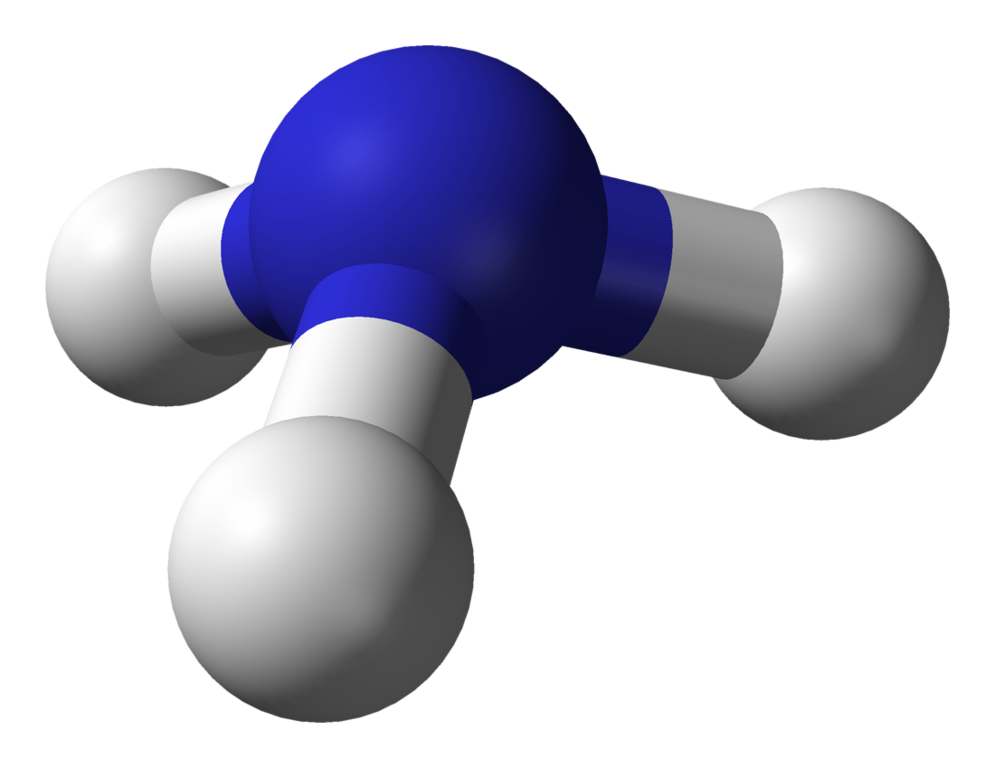
[[File:995px-Ammonia-3D-balls-A.png|360px|thumb|right|Figure 1. A ball and stick diagram of ammonia. The white balls | [[File:995px-Ammonia-3D-balls-A.png|360px|thumb|right|Figure 1. A ball and stick diagram of ammonia. The white balls represent [[hydrogen]] and the blue ball represents [[nitrogen]].<ref>Wikimedia Commons. (September 8, 2015). ''Ammonia 3D Model'' [Online]. Available: https://upload.wikimedia.org/wikipedia/commons/thumb/0/05/Ammonia-3D-balls-A.png/995px-Ammonia-3D-balls-A.png</ref> Each bond is a single covalent bond and there is a lone pair on the nitrogen, resulting in its trigonal pyramidal shape. ]] | ||
<onlyinclude>'''Ammonia''' is a [[chemical]] with the formula NH<sub>3</sub>. At room [[temperature]], it is a colourless [[gas]], with a pungent odour that is highly irritating. Ammonia is classified as a [[base (chemistry)|base]], and is fairly corrosive.</onlyinclude> When put under enough [[pressure]], ammonia gas forms a clear [[liquid]] and is generally shipped in this form. It is not highly [[flammable]].<ref name="RE1">Department of Health, New York. (September 8, 2015). ''The Facts About Ammonia'' [Online]. Available: https://www.health.ny.gov/environmental/emergency/chemical_terrorism/ammonia_tech.htm</ref> Some additional properties | <onlyinclude>'''Ammonia''' is a [[chemical]] with the formula NH<sub>3</sub>. At room [[temperature]], it is a colourless [[gas]], with a pungent odour that is highly irritating. Ammonia is classified as a [[base (chemistry)|base]], and is fairly corrosive.</onlyinclude> When put under enough [[pressure]], ammonia gas forms a clear [[liquid]] and is generally shipped in this form. It is not highly [[flammable]].<ref name="RE1">Department of Health, New York. (September 8, 2015). ''The Facts About Ammonia'' [Online]. Available: https://www.health.ny.gov/environmental/emergency/chemical_terrorism/ammonia_tech.htm</ref> Figure 1 shows the molecular structure of ammonia. Some additional properties are shown in the table below. | ||
{| class="wikitable" | {| class="wikitable" | ||
| Line 20: | Line 20: | ||
Ammonia has a wide range of uses, but the majority of ammonia produced (~80%)<ref name="RE1"/> is used in agriculture as a fertilizer. This process allows soils to become more nitrogen rich. Ammonia can also be used as a [[refrigerant]] gas and is used in the manufacturing of plastics, explosives, textiles, pesticides, dyes, and other chemicals. Additionally, ammonia can be used as a cleaning solution in both household and industrial applications.<ref name="RE1"/> | Ammonia has a wide range of uses, but the majority of ammonia produced (~80%)<ref name="RE1"/> is used in agriculture as a fertilizer. This process allows soils to become more nitrogen rich. Ammonia can also be used as a [[refrigerant]] gas and is used in the manufacturing of plastics, explosives, textiles, pesticides, dyes, and other chemicals. Additionally, ammonia can be used as a cleaning solution in both household and industrial applications.<ref name="RE1"/> | ||
In the [[petroleum]] industry, ammonia is used to neutralize [[acid]]ic components of [[crude oil]]. In mining, ammonia is used to extract [[copper]], [[nickel]], and [[molybdenum]] from their [[ore]]s. In waste water treatment, ammonia is used to control the [[pH]] of the water. Finally, ammonia is used to clean [[exhaust gas]]es from [[smokestack]]s, removing [[SOx|sulfur oxides]] and [[NOx]]. This enhances the [[efficiency]] of [[electrostatic precipitator]]s.<ref>RM Tech. (September 8, 2015). ''Uses of Ammonia'' [Online]. Available: http://www.rmtech.net/uses_of_ammonia.htm</ref> | |||
==Health Effects== | ==Health Effects== | ||
Depending on how a person is exposed to ammonia, the health effects vary. When inhaled, ammonia acts as an irritant and burns the nose, throat, and respiratory tract. This inhalation of the corrosive chemical can result in respiratory distress. At lower concentrations this can lead to coughing. This exposure is more harmful to | Depending on how a person is exposed to ammonia, the health effects vary. When inhaled, ammonia acts as an irritant and burns the nose, throat, and respiratory tract. This inhalation of the corrosive chemical can result in respiratory distress. At lower concentrations this can lead to coughing. This exposure is more harmful to people with reduced respiratory functions.<ref name="RE1"/> | ||
If ammonia comes into contact with the eyes or skin, it can cause irritation and burning. Extended exposure to ammonia can result in blindness and eye damage. If ingested, ammonia can burn the mouth, throat, and stomach.<ref name="RE1"/> | If ammonia comes into contact with the eyes or skin, it can cause irritation and burning. Extended exposure to ammonia can result in blindness and eye damage. If ingested, ammonia can burn the mouth, throat, and stomach.<ref name="RE1"/> | ||
== For Further Reading == | |||
* [[Hydrogen]] | |||
* [[Nitrogen]] | |||
* [[Base (chemistry)|Base]] | |||
* Or explore a [[Special:Random|random page]] | |||
==References== | ==References== | ||
{{reflist}} | {{reflist}}[[Category:Uploaded]] | ||
Revision as of 23:43, 27 May 2026

Ammonia is a chemical with the formula NH3. At room temperature, it is a colourless gas, with a pungent odour that is highly irritating. Ammonia is classified as a base, and is fairly corrosive. When put under enough pressure, ammonia gas forms a clear liquid and is generally shipped in this form. It is not highly flammable.[2] Figure 1 shows the molecular structure of ammonia. Some additional properties are shown in the table below.
| Chemical formula | NH3 |
| Molar mass | 17.031 grams/mole |
| Melting point | -77.73oC[3] |
| Boiling point | -33.34oC[3] |
Ammonia is a chemical that is essential for plant, animal, and human life. It is a natural component of the air, water, and soil and acts as a nitrogen source for plants and animals. However, in high quantities ammonia can be harmful for human health.[4]
Uses
Ammonia has a wide range of uses, but the majority of ammonia produced (~80%)[2] is used in agriculture as a fertilizer. This process allows soils to become more nitrogen rich. Ammonia can also be used as a refrigerant gas and is used in the manufacturing of plastics, explosives, textiles, pesticides, dyes, and other chemicals. Additionally, ammonia can be used as a cleaning solution in both household and industrial applications.[2]
In the petroleum industry, ammonia is used to neutralize acidic components of crude oil. In mining, ammonia is used to extract copper, nickel, and molybdenum from their ores. In waste water treatment, ammonia is used to control the pH of the water. Finally, ammonia is used to clean exhaust gases from smokestacks, removing sulfur oxides and NOx. This enhances the efficiency of electrostatic precipitators.[5]
Health Effects
Depending on how a person is exposed to ammonia, the health effects vary. When inhaled, ammonia acts as an irritant and burns the nose, throat, and respiratory tract. This inhalation of the corrosive chemical can result in respiratory distress. At lower concentrations this can lead to coughing. This exposure is more harmful to people with reduced respiratory functions.[2]
If ammonia comes into contact with the eyes or skin, it can cause irritation and burning. Extended exposure to ammonia can result in blindness and eye damage. If ingested, ammonia can burn the mouth, throat, and stomach.[2]
For Further Reading
- Hydrogen
- Nitrogen
- Base
- Or explore a random page
References
- ↑ Wikimedia Commons. (September 8, 2015). Ammonia 3D Model [Online]. Available: https://upload.wikimedia.org/wikipedia/commons/thumb/0/05/Ammonia-3D-balls-A.png/995px-Ammonia-3D-balls-A.png
- ↑ 2.0 2.1 2.2 2.3 2.4 Department of Health, New York. (September 8, 2015). The Facts About Ammonia [Online]. Available: https://www.health.ny.gov/environmental/emergency/chemical_terrorism/ammonia_tech.htm
- ↑ 3.0 3.1 PubChem. (September 8, 2015). Ammonia [Online]. Available: http://pubchem.ncbi.nlm.nih.gov/compound/ammonia
- ↑ The Fertilizer Institute. (September 8, 2015). Health Effects of Ammonia [Online]. Available: https://www.tfi.org/sites/default/files/documents/healthammonia2014.pdf
- ↑ RM Tech. (September 8, 2015). Uses of Ammonia [Online]. Available: http://www.rmtech.net/uses_of_ammonia.htm