
Venturi effect: Difference between revisions
J.williams (talk | contribs) m 1 revision imported |
No edit summary |
||
| Line 1: | Line 1: | ||
[[Category:Done 2015- | [[Category: Done 2015-09-06]] | ||
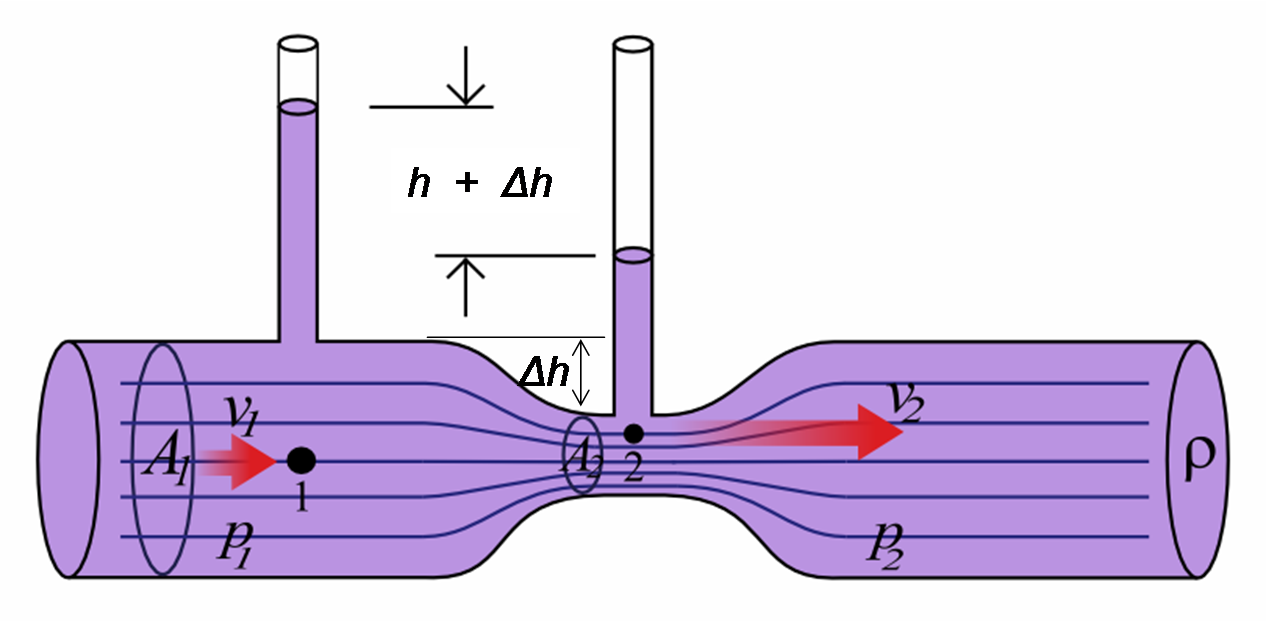
[[File:Venturifixed2.PNG|400px|thumb|Figure 1. A diagram demonstrating the Venturi effect. The fluid flows faster in at point 2 than at point 1 due to the decrease in cross-sectional area. The [[pressure]] at point 1 is higher however, due to the [[conservation of energy]].<ref>Wikimedia Commons [Online], Available: https://upload.wikimedia.org/wikipedia/commons/5/54/Venturifixed2.PNG</ref>]] | [[File:Venturifixed2.PNG|400px|thumb|Figure 1. A diagram demonstrating the Venturi effect. The fluid flows faster in at point 2 than at point 1 due to the decrease in cross-sectional area. The [[pressure]] at point 1 is higher however, due to the [[conservation of energy]].<ref>Wikimedia Commons [Online], Available: https://upload.wikimedia.org/wikipedia/commons/5/54/Venturifixed2.PNG</ref>]] | ||
<onlyinclude>The '''Venturi effect''' describes how the [[velocity]] of the [[fluid]] increases (thus increasing the [[kinetic energy]] of the water) as the cross section of the container decreases, like in a funnel.</onlyinclude> In the case of tidal stream generators a duct or shroud (otherwise known as a diffuser) can be used to increase the amount of power available. A funnel shape is built around or near the [[turbine]] that causes the flow rate of the water to accelerate - sometimes dramatically. These can cause up to 4 or 5 times higher power output than a similar sized turbine without a shroud because it's harnessing the energy from a greater amount of water.<ref name=Ref11>Wise Geek. (August 7, 2015). ''What is a Venturi tube?'' [Online], Available: http://www.wisegeek.com/what-is-a-venturi-tube.htm</ref> | <onlyinclude>The '''Venturi effect''' describes how the [[velocity]] of the [[fluid]] increases (thus increasing the [[kinetic energy]] of the [[water]]) as the cross section of the container decreases, like in a funnel.</onlyinclude> In the case of tidal stream generators a duct or shroud (otherwise known as a diffuser) can be used to increase the amount of [[power]] available. A funnel shape is built around or near the [[turbine]] that causes the [[flow rate]] of the water to accelerate - sometimes dramatically. These can cause up to 4 or 5 times higher power output than a similar sized turbine without a shroud because it's harnessing the [[energy]] from a greater amount of water.<ref name=Ref11>Wise Geek. (August 7, 2015). ''What is a Venturi tube?'' [Online], Available: http://www.wisegeek.com/what-is-a-venturi-tube.htm</ref> | ||
Many different styles of [[tidal stream generator]]s can harness the Venturi effect. | Many different styles of [[tidal stream generator]]s can harness the Venturi effect. | ||
Revision as of 21:04, 3 September 2015

The Venturi effect describes how the velocity of the fluid increases (thus increasing the kinetic energy of the water) as the cross section of the container decreases, like in a funnel. In the case of tidal stream generators a duct or shroud (otherwise known as a diffuser) can be used to increase the amount of power available. A funnel shape is built around or near the turbine that causes the flow rate of the water to accelerate - sometimes dramatically. These can cause up to 4 or 5 times higher power output than a similar sized turbine without a shroud because it's harnessing the energy from a greater amount of water.[2]
Many different styles of tidal stream generators can harness the Venturi effect.
References
- ↑ Wikimedia Commons [Online], Available: https://upload.wikimedia.org/wikipedia/commons/5/54/Venturifixed2.PNG
- ↑ Wise Geek. (August 7, 2015). What is a Venturi tube? [Online], Available: http://www.wisegeek.com/what-is-a-venturi-tube.htm