
Offshore drilling: Difference between revisions
m 1 revision imported |
Energy>Jmdonev No edit summary |
||
| Line 1: | Line 1: | ||
[[Category:Done | [[Category:Done 2026-06-01]] | ||
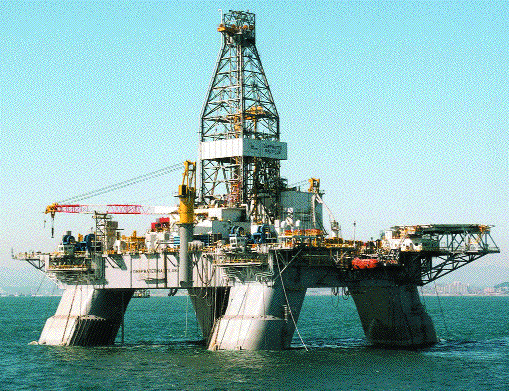
[[File:Mobile-offshore-drilling-unit.gif|360px|thumb|Figure 1. An offshore drilling rig.<ref>Wikimedia Commons. (September 19, 2015). ''Mobile Offshore Drilling Unit'' [Online]. Available: https://upload.wikimedia.org/wikipedia/commons/7/75/Mobile-offshore-drilling-unit.gif</ref>]] | [[File:Mobile-offshore-drilling-unit.gif|360px|thumb|Figure 1. An offshore drilling rig.<ref>Wikimedia Commons. (September 19, 2015). ''Mobile Offshore Drilling Unit'' [Online]. Available: https://upload.wikimedia.org/wikipedia/commons/7/75/Mobile-offshore-drilling-unit.gif</ref>]] | ||
<onlyinclude>'''Offshore drilling''' is the process of extracting [[petroleum]] from [[reserve]]s located beneath the Earth's [[ocean]]s instead of reserves located on the mainland.</onlyinclude> [[Offshore oil rig]]s have developed greatly over the past years, and have become gigantic structures that house hundreds of people at a time. Some facilities sit on towers that go to depths of 1220 [[meter]]s below the surface, larger than any skyscraper ever conceived of.<ref name="RE1"/><ref>As of the writing of this page the tallest skyscraper in the world is Burj Khalifa at 828 m, with the CN Tower in Canada (no longer on the top 10 list) at | <onlyinclude>'''Offshore drilling''' is the process of extracting [[petroleum]] from [[reserve]]s located beneath the Earth's [[ocean]]s instead of reserves located on the mainland.</onlyinclude> [[Offshore oil rig]]s have developed greatly over the past years, and have become gigantic structures that house hundreds of people at a time. Some facilities sit on towers that go to depths of 1220 [[meter]]s below the surface, larger than any skyscraper ever conceived of.<ref name="RE1"/><ref>As of the writing of this page the tallest skyscraper in the world is Burj Khalifa at 828 m, with the CN Tower in Canada (no longer on the top 10 list) at 553 m (from http://skyscrapercenter.com/buildings and https://www.cntower.ca/explore-the-tower respectively).</ref> | ||
==Why is it Needed?== | ==Why is it Needed?== | ||
Offshore drilling is popular because of the large amount of [[oil]] and other petroleum products used worldwide each day. The IEA estimates the current worldwide demand of oil exceeds 100 million [[barrel]]s ''per day''.<ref> | |||
IEA. ( | IEA (2026). (Accessed May 14, 2026). ''Oil Market Report - May 2026'' [Online]. Available: https://www.iea.org/reports/oil-market-report-may-2026</ref> To meet this demand for [[fossil fuel]]s, petroleum companies are faced with the task of searching in more remote locations to discover new reserves. Since oceans cover almost three quarters of the Earth's surface, a large amount of the oil and [[natural gas]] reserves around the globe are located beneath water.<ref name="RE1">Robert Lamb. (January 6, 2016). ''How Offshore Drilling Works'' [Online]. Available: http://science.howstuffworks.com/environmental/energy/offshore-drilling.htm</ref> | ||
==Drilling Process== | ==Drilling Process== | ||
The process of drilling for oil and natural gas underseas is much more challenging than drilling on land. Extraction, transportation, and environmental protection are all comparatively more difficult with offshore drilling than with traditional wells. In an attempt to make this process more simple, petroleum companies have developed offshore oil platforms to aid in this extraction. | The process of drilling for oil and natural gas underseas is much more challenging than drilling on land. Extraction, transportation, and environmental protection are all comparatively more difficult with offshore drilling than with traditional wells. In an attempt to make this process more simple, petroleum companies have developed offshore oil platforms to aid in this extraction. | ||
[[File:Subsea drill templatepng.png|left|thumb|Figure 2. A subsea drilling template.<ref>Claxton (2025). (Accessed May 15, 2026). ''Drilling Templates'' [Online]. Available: https://claxtonengineering.com/conventional-energy-services/drilling-risers/drilling-templates/</ref>]] | |||
Once the offshore drilling platform is built, some method of extracting the oil and gas from beneath the ocean and moving it to the surface without losing it must be developed. To drill without water flowing into the hole or having all the oil surge up into the ocean, a subsea drilling template is used. This template is simply a large metal box with holes in it that is used to guide the drilling process and marks the site of each production well. Once the locations of the drilling sites are marked with this template, the drilling process can begin. To drill these wells, a number of 9 meter '''drill pipes''' are connected end-to-end to form a large '''drill string''' used to reach deep into the Earth's crust.<ref name="RE1" /><ref>Sinodrills (2025). (Accessed May 15, 2026). ''Drill String: What It Is and How It Works'' [Online]. Available: https://www.sinodrills.com/drill-string/</ref> Once connected, this string of drill pipes is connected to a device that spins it around. The '''drill bit''' connected at the bottom of the drill string grinds down into the Earth's surface. This drilling process can take a long period of time, lasting anywhere from weeks to months.<ref name="RE1" /> During this time, if the bit becomes dull and needs replacement the equipment is moved to | |||
the ocean floor in a tube known as a '''marine riser'''.[[File:Drill bit.jpg|thumb|Figure 3. Drill bit.<ref>Jamstec (2018). (Accessed May 15, 2026). ''Chikyu Photos'' [Online]. Available: https://www.jamstec.go.jp/chikyu/e/outreach/portfolio/photos/chikyuphotos.html</ref>]]As the [[borehole]] moves deeper into the ground, a stream of drilling mud is sent to the drill bit, and then moves back up to the platform. This mud is vitally important to the drilling process as it provides lubrication for the drill bit, seals the wall of the well, and controls [[pressure]] inside of the well. Any rock particulates broken off during the drilling process are brought up to the surface, suspended in the [[drilling mud]]. A filtration system on the platform filters the mud before sending it to the ocean floor again. Drilling itself happens in phases, with a length of the well drilled and then lined with metallic casing. Each phase of drilling creates a portion of the well with a smaller diameter, each portion lined with casing. Once drilled and cased, a '''packer''' is sent down the well which expands and ensures the well is sealed.<ref name="RE1" /> | |||
As the [[borehole]] moves deeper into the ground, a stream of drilling mud is sent to the drill bit, and then moves back up to the platform. This mud is vitally important to the drilling process as it provides lubrication for the drill bit, seals the wall of the well, and controls [[pressure]] inside of the well. Any rock particulates broken off during the drilling process are brought up to the surface, suspended in the [[drilling mud]]. A filtration system on the platform filters the mud before sending it to the ocean floor again. Drilling itself happens in phases, with a length of the well drilled and then lined with metallic casing. Each phase of drilling creates a portion of the well with a smaller diameter, each portion lined with casing. Once drilled and cased, a '''packer''' is sent down the well which expands and ensures the well is sealed.<ref name="RE1"/> | |||
Although drilling mud helps to control the high pressure experienced when drilling, there is a significant risk of blowout. To prevent this from occurring, drilling rigs are equipped with a '''[[blowout prevention system]]''' on the seafloor. These systems act by sealing the well with hydraulic rams if pressurized petroleum pushes up the well, moving expelled fluids into containment systems to prevent pollution. | Although drilling mud helps to control the high pressure experienced when drilling, there is a significant risk of blowout. To prevent this from occurring, drilling rigs are equipped with a '''[[blowout prevention system]]''' on the seafloor. These systems act by sealing the well with hydraulic rams if pressurized petroleum pushes up the well, moving expelled fluids into containment systems to prevent pollution. | ||
| Line 23: | Line 23: | ||
Since the liquid that is brought up to the platform is a mixture of [[crude oil]], natural gas, [[water]], and [[sediment]]s, some drilling platforms contain full production facilities to separate this mixture. Although most [[oil refinery|refinement]] occurs onshore, some companies use converted oil tankers to treat and store oil at sea. Once some initial treatment has occurred, undersea pipelines and oil tankers [[transportation of oil|transport the oil]] and natural gas to storage and treatment onshore. | Since the liquid that is brought up to the platform is a mixture of [[crude oil]], natural gas, [[water]], and [[sediment]]s, some drilling platforms contain full production facilities to separate this mixture. Although most [[oil refinery|refinement]] occurs onshore, some companies use converted oil tankers to treat and store oil at sea. Once some initial treatment has occurred, undersea pipelines and oil tankers [[transportation of oil|transport the oil]] and natural gas to storage and treatment onshore. | ||
==For Further Reading== | |||
*[[Oil]] | |||
*[[Peak oil]] | |||
*[[Reserve vs occurrence]] | |||
*[[Fossil fuel extraction]] | |||
*[[Climate change]] | |||
*Or explore a [[Special:Random|random page]] | |||
==References== | ==References== | ||
{{reflist}} | {{reflist}} | ||
[[Category:Uploaded]] | |||
Revision as of 22:56, 15 May 2026

Offshore drilling is the process of extracting petroleum from reserves located beneath the Earth's oceans instead of reserves located on the mainland. Offshore oil rigs have developed greatly over the past years, and have become gigantic structures that house hundreds of people at a time. Some facilities sit on towers that go to depths of 1220 meters below the surface, larger than any skyscraper ever conceived of.[2][3]
Why is it Needed?
Offshore drilling is popular because of the large amount of oil and other petroleum products used worldwide each day. The IEA estimates the current worldwide demand of oil exceeds 100 million barrels per day.[4] To meet this demand for fossil fuels, petroleum companies are faced with the task of searching in more remote locations to discover new reserves. Since oceans cover almost three quarters of the Earth's surface, a large amount of the oil and natural gas reserves around the globe are located beneath water.[2]
Drilling Process
The process of drilling for oil and natural gas underseas is much more challenging than drilling on land. Extraction, transportation, and environmental protection are all comparatively more difficult with offshore drilling than with traditional wells. In an attempt to make this process more simple, petroleum companies have developed offshore oil platforms to aid in this extraction.

Once the offshore drilling platform is built, some method of extracting the oil and gas from beneath the ocean and moving it to the surface without losing it must be developed. To drill without water flowing into the hole or having all the oil surge up into the ocean, a subsea drilling template is used. This template is simply a large metal box with holes in it that is used to guide the drilling process and marks the site of each production well. Once the locations of the drilling sites are marked with this template, the drilling process can begin. To drill these wells, a number of 9 meter drill pipes are connected end-to-end to form a large drill string used to reach deep into the Earth's crust.[2][6] Once connected, this string of drill pipes is connected to a device that spins it around. The drill bit connected at the bottom of the drill string grinds down into the Earth's surface. This drilling process can take a long period of time, lasting anywhere from weeks to months.[2] During this time, if the bit becomes dull and needs replacement the equipment is moved to
the ocean floor in a tube known as a marine riser.

As the borehole moves deeper into the ground, a stream of drilling mud is sent to the drill bit, and then moves back up to the platform. This mud is vitally important to the drilling process as it provides lubrication for the drill bit, seals the wall of the well, and controls pressure inside of the well. Any rock particulates broken off during the drilling process are brought up to the surface, suspended in the drilling mud. A filtration system on the platform filters the mud before sending it to the ocean floor again. Drilling itself happens in phases, with a length of the well drilled and then lined with metallic casing. Each phase of drilling creates a portion of the well with a smaller diameter, each portion lined with casing. Once drilled and cased, a packer is sent down the well which expands and ensures the well is sealed.[2]
Although drilling mud helps to control the high pressure experienced when drilling, there is a significant risk of blowout. To prevent this from occurring, drilling rigs are equipped with a blowout prevention system on the seafloor. These systems act by sealing the well with hydraulic rams if pressurized petroleum pushes up the well, moving expelled fluids into containment systems to prevent pollution.
Extraction Process
Once the well has been drilled, the final portion of casing known as the production casing is installed. This casing ends in a cap that closes the well, allowing the flow of petroleum into the well to be controlled. Explosives are sent below ground to crack this production casing at a variety of depths to allow oil and gas to enter the well in a controlled manner and move to the surface at a reasonable pressure.
When first drilled, the pressure from the reservoir is enough to send fluids to the surface, but as this pressure declines pumps may be needed. Sometimes, water or gas is pumped into the reservoir, increasing the reservoir pressure and allowing petroleum to flow again. In some cases, steam is sent down a well to heat the petroleum, increasing its pressure.
Since the liquid that is brought up to the platform is a mixture of crude oil, natural gas, water, and sediments, some drilling platforms contain full production facilities to separate this mixture. Although most refinement occurs onshore, some companies use converted oil tankers to treat and store oil at sea. Once some initial treatment has occurred, undersea pipelines and oil tankers transport the oil and natural gas to storage and treatment onshore.
For Further Reading
References
- ↑ Wikimedia Commons. (September 19, 2015). Mobile Offshore Drilling Unit [Online]. Available: https://upload.wikimedia.org/wikipedia/commons/7/75/Mobile-offshore-drilling-unit.gif
- ↑ 2.0 2.1 2.2 2.3 2.4 Robert Lamb. (January 6, 2016). How Offshore Drilling Works [Online]. Available: http://science.howstuffworks.com/environmental/energy/offshore-drilling.htm
- ↑ As of the writing of this page the tallest skyscraper in the world is Burj Khalifa at 828 m, with the CN Tower in Canada (no longer on the top 10 list) at 553 m (from http://skyscrapercenter.com/buildings and https://www.cntower.ca/explore-the-tower respectively).
- ↑ IEA (2026). (Accessed May 14, 2026). Oil Market Report - May 2026 [Online]. Available: https://www.iea.org/reports/oil-market-report-may-2026
- ↑ Claxton (2025). (Accessed May 15, 2026). Drilling Templates [Online]. Available: https://claxtonengineering.com/conventional-energy-services/drilling-risers/drilling-templates/
- ↑ Sinodrills (2025). (Accessed May 15, 2026). Drill String: What It Is and How It Works [Online]. Available: https://www.sinodrills.com/drill-string/
- ↑ Jamstec (2018). (Accessed May 15, 2026). Chikyu Photos [Online]. Available: https://www.jamstec.go.jp/chikyu/e/outreach/portfolio/photos/chikyuphotos.html