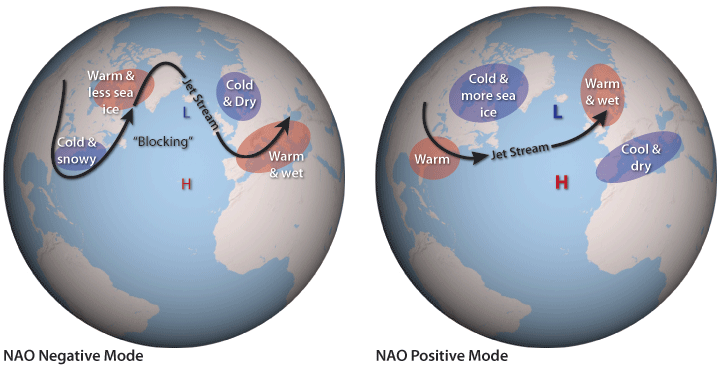

Modes of climate variability
Climate can be defined as the long-term trends of the weather. While both climate and weather are fundamental to the atmosphere, they are affected by cooperation between the atmosphere and the ocean, the biosphere, the land surface, and the cryosphere. These components exchange mass, momentum and energy on all time scales. As a consequence, global or regional scale climate variables such as the sea surface temperature, the rainfall, the surface pressure or the wind speed fluctuate somewhat regularly.[1] This regular fluctuation is a natural form of climate variability, which are individually known as modes or oscillations. Their phases and states are monitored by different types of climate models. There are many known oscillations which extend over large areas across the globe. Examples include:

- North Atlantic Oscillation (NAO)
- Atlantic Multidecadal Oscillation (AMO)
- Pacific North American pattern (PNA)
- Pacific Decadal Oscillation (PDO)
- El Niño-Southern Oscillation (ENSO)
- Northern Annular Mode (NAM; previously called the Arctic Oscillation, AO)
- Southern Annular Mode (SAM; previously called the Antarctic Oscillation, AAO).
These patterns vary over a large range of space and time scales, and their fluctuations can impact global and regional temperature variations.[3]
For Further Reading
- Climate
- Climate variability
- Weather
- Explore the list of examples above
- Or explore a random page
References
- ↑ "Global modes of climate variability", 2016. [Online]. Available: http://research.atmos.ucla.edu/tcd//PREPRINTS/OdV&co-Global_modes-preprint_grl50386.pdf. [Accessed: 22- Jul- 2016].
- ↑ National Oceanic and Atmospheric Administration. (July 22, 2016). ‘’NAO Modes’’ [Online]. Available: https://www.climate.gov/sites/default/files/NAO_Schematic_0.png
- ↑ "Decade-to-Century-Scale Climate Variability and Change", National Academy Press, pp. 25-26, 1998.