
Trombe wall: Difference between revisions
J.williams (talk | contribs) m 1 revision imported |
m 1 revision imported |
||
| (One intermediate revision by one other user not shown) | |||
| Line 1: | Line 1: | ||
<onlyinclude> | |||
[[File: | [[File:Trombe wall img.jpg|thumb|Figure 1. A picture of a Trombe wall.<ref>Wikimedia Commons (2010). (Accessed May 19, 2026). ''Trombe mur'' [Online]. Available: https://commons.wikimedia.org/wiki/File:Trombe_mur.JPG</ref>]] | ||
'''Trombe walls''' are a type of technology that can be installed in homes to [[passive solar heating and cooling|passively heat the building]]. The inclusion of Trombe walls reduces the need to heat the building using traditional methods such as [[furnace]]s or other [[space heating|space heaters]], reducing the amount of [[energy]] used to [[heat]] the home. Like a [[solar chimney]] or [[solar wall]], Trombe walls are a way to achieve [[energy efficient building design]].</onlyinclude><ref name="RE1">Autodesk Sustainability Workshop. (August 10, 2015). ''Trombe Walls and Sunspaces'' [Online]. Available: http://sustainabilityworkshop.autodesk.com/buildings/trombe-wall-and-attached-sunspace</ref> These walls are beneficial as they require little to no effort to operate and are ideal for spaces where quiet and privacy is desirable. | |||
These walls are built of some dark-coloured material (sometimes concrete) that is built facing the [[Sun]] so that the [[solar radiation]] is incident on this wall. The [[wall assembly|wall]] is then covered with an exterior [[glazing]], with a small amount of [[air]] between the wall and the glazing. This glazing works to trap the [[sunlight]] like a small greenhouse.<ref name="RE1"/> In the Northern hemisphere these walls are south facing. For an explanation of ''why'' it is the south facing wall, click [[Solar collector orientation|here]]. | |||
==How They Work== | |||
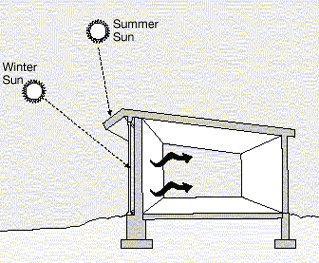
[[File:Illust_passive_solar_d2_319pxW.gif|framed|Figure 2. A diagram of a Trombe wall.<ref>Wikimedia Commons. (August 6, 2015). ''Trombe Wall'' [Online]. Available: https://upload.wikimedia.org/wikipedia/commons/3/3d/Illust_passive_solar_d2_319pxW.gif</ref>|left]]For a Trombe wall to work properly, during cold seasons it must be built to maximize the total heat gain from the Sun while minimizing any losses that occur. During hot seasons, they shouldn't gain heat. | |||
In the winter daytime, Trombe walls facing the Sun have sunlight incident upon them. The wall absorbs and stores the heat coming from the direct solar radiation. Cool air from the building enters the air channel between the wall and the glazing through a vent present at the bottom of the wall. The cool air enters the space at the bottom, and is heated by the heat stored in the concrete wall.<ref name="RE1" /> As this occurs, the warming air rises and is fed back into the building through a vent present at the top of the wall.<ref name="Article1"> H. Chan. S. Riffat and J. Zhu. “Review of Passive Solar Heating and Cooling Technologies.” Renewable and Sustainable Energy Reviews, vol. 14, pp. 781-789, February 2010.</ref> On top of that, the wall itself heats the inside room slowly by radiating its heat into the room. | |||
At night, a Trombe wall functions differently. The vents at the top and bottom of the wall are closed to ensure that the now cool air in the channel between the glazing and the wall doesn't re-enter the home. Heat absorbed by the concrete wall is still able to maintain a comfortably warm internal space overnight.<ref name="RE1"/> | At night, a Trombe wall functions differently. The vents at the top and bottom of the wall are closed to ensure that the now cool air in the channel between the glazing and the wall doesn't re-enter the home. Heat absorbed by the concrete wall is still able to maintain a comfortably warm internal space overnight.<ref name="RE1"/> | ||
In order to prevent over-heating in the summer, a roof overhang or other [[shading technology|shading technologies]] can be used to block excessive solar radiation from hitting the Trombe wall and heating it.<ref name=Article2> W. Feist. “First Steps: What Can be a Passive House in Your Region with Your Climate?” Internet: http://passive.bg/files/files/83dede941ff2a5e60dd8e0d1cbfc24acFirstStep.pdf, [Sept. 19, 2013]</ref> | In order to prevent over-heating in the summer, a roof overhang or other [[shading technology|shading technologies]] can be used to block excessive solar radiation from hitting the Trombe wall and heating it.<ref name=Article2> W. Feist. “First Steps: What Can be a Passive House in Your Region with Your Climate?” Internet: http://passive.bg/files/files/83dede941ff2a5e60dd8e0d1cbfc24acFirstStep.pdf, [Sept. 19, 2013]</ref> | ||
== For Further Reading == | |||
* [[Passive solar heating and cooling]] | |||
* [[Solar chimney]] | |||
* [[Solar wall]] | |||
* [[Thermal mass]] | |||
* [[Curtain wall]] | |||
* Or explore a [[Special:Random|random page]] | |||
==References== | ==References== | ||
{{reflist}} | {{reflist}} | ||
[[Category:Uploaded]] | [[Category:Uploaded]] | ||
[[Category:Done 2026-06-01]] | |||
Latest revision as of 17:16, 4 June 2026

Trombe walls are a type of technology that can be installed in homes to passively heat the building. The inclusion of Trombe walls reduces the need to heat the building using traditional methods such as furnaces or other space heaters, reducing the amount of energy used to heat the home. Like a solar chimney or solar wall, Trombe walls are a way to achieve energy efficient building design.[2] These walls are beneficial as they require little to no effort to operate and are ideal for spaces where quiet and privacy is desirable.
These walls are built of some dark-coloured material (sometimes concrete) that is built facing the Sun so that the solar radiation is incident on this wall. The wall is then covered with an exterior glazing, with a small amount of air between the wall and the glazing. This glazing works to trap the sunlight like a small greenhouse.[2] In the Northern hemisphere these walls are south facing. For an explanation of why it is the south facing wall, click here.
How They Work

For a Trombe wall to work properly, during cold seasons it must be built to maximize the total heat gain from the Sun while minimizing any losses that occur. During hot seasons, they shouldn't gain heat.
In the winter daytime, Trombe walls facing the Sun have sunlight incident upon them. The wall absorbs and stores the heat coming from the direct solar radiation. Cool air from the building enters the air channel between the wall and the glazing through a vent present at the bottom of the wall. The cool air enters the space at the bottom, and is heated by the heat stored in the concrete wall.[2] As this occurs, the warming air rises and is fed back into the building through a vent present at the top of the wall.[4] On top of that, the wall itself heats the inside room slowly by radiating its heat into the room.
At night, a Trombe wall functions differently. The vents at the top and bottom of the wall are closed to ensure that the now cool air in the channel between the glazing and the wall doesn't re-enter the home. Heat absorbed by the concrete wall is still able to maintain a comfortably warm internal space overnight.[2]
In order to prevent over-heating in the summer, a roof overhang or other shading technologies can be used to block excessive solar radiation from hitting the Trombe wall and heating it.[5]
For Further Reading
- Passive solar heating and cooling
- Solar chimney
- Solar wall
- Thermal mass
- Curtain wall
- Or explore a random page
References
- ↑ Wikimedia Commons (2010). (Accessed May 19, 2026). Trombe mur [Online]. Available: https://commons.wikimedia.org/wiki/File:Trombe_mur.JPG
- ↑ 2.0 2.1 2.2 2.3 Autodesk Sustainability Workshop. (August 10, 2015). Trombe Walls and Sunspaces [Online]. Available: http://sustainabilityworkshop.autodesk.com/buildings/trombe-wall-and-attached-sunspace
- ↑ Wikimedia Commons. (August 6, 2015). Trombe Wall [Online]. Available: https://upload.wikimedia.org/wikipedia/commons/3/3d/Illust_passive_solar_d2_319pxW.gif
- ↑ H. Chan. S. Riffat and J. Zhu. “Review of Passive Solar Heating and Cooling Technologies.” Renewable and Sustainable Energy Reviews, vol. 14, pp. 781-789, February 2010.
- ↑ W. Feist. “First Steps: What Can be a Passive House in Your Region with Your Climate?” Internet: http://passive.bg/files/files/83dede941ff2a5e60dd8e0d1cbfc24acFirstStep.pdf, [Sept. 19, 2013]