
Aerosol: Difference between revisions
No edit summary |
m 1 revision imported |
||
| (One intermediate revision by one other user not shown) | |||
| Line 1: | Line 1: | ||
[[Category:Done | [[Category:Done 2026-08-01]] | ||
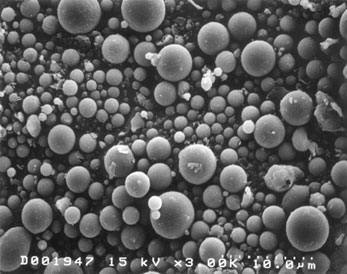
[[File:Fly_Ash_FHWA_dot_gov.jpg|300px|thumb|Figure 1. A Scanning Tunnel Microscope image of [[fly ash]], a type of aerosol emitted by the burning of [[coal]].<ref>Wikimedia Commons [Online], Available: https://upload.wikimedia.org/wikipedia/commons/6/6f/Fly_Ash_FHWA_dot_gov.jpg</ref>]] | [[File:Fly_Ash_FHWA_dot_gov.jpg|300px|thumb|Figure 1. A Scanning Tunnel Microscope image of [[fly ash]], a type of aerosol emitted by the burning of [[coal]].<ref>Wikimedia Commons [Online], Available: https://upload.wikimedia.org/wikipedia/commons/6/6f/Fly_Ash_FHWA_dot_gov.jpg</ref>]] | ||
<onlyinclude>'''Aerosols''' are any small [[liquid]] or [[solid]] particles suspended in the [[atmosphere]], excluding large cloud or [[precipitation]] particles.<ref name=ipcc1/> | <onlyinclude>'''Aerosols''' are any small [[liquid]] or [[solid]] particles suspended in the [[atmosphere]], excluding large cloud or [[precipitation]] particles.<ref name=ipcc1/> Both natural and [[anthropogenic]] sources release into the atmosphere and interact with various global systems in complex ways. </onlyinclude> | ||
Two major interactions of aerosols with the [[environment]] are [[radiative forcing]] (how the particles interact with incoming [[sunlight]]) | Two major interactions of aerosols with the [[environment]] are [[radiative forcing]] (which is how the particles interact with incoming [[sunlight]]) and '''cloud interactions'''.<ref name=ipcc1>IPCC. (Accessed January 2, 2016). ''Frequently Asked Questions,'' FAQ 7.2, page 31-32 of report, Available: http://www.climatechange2013.org/images/report/WG1AR5_FAQbrochure_FINAL.pdf#25</ref> These interactions impact the global [[climate]] in many ways, explored below. | ||
Aerosols vary greatly in size, composition | Aerosols vary greatly in size, composition, shape, and lifespan; see Figure 1 as an example. Their lifespan depends on their location in the atmosphere, lasting anywhere from a couple of weeks up to a year. Examples of natural aerosols include dust such as from deserts, and volcanic aerosols such as volcanic [[sulfur oxides]]. Anthropogenic aerosols include [[particulate matter]] (PM) such as [[soot]] and [[coal ash]], forms of dust, [[smoke]], and more.<Ref name=nasa1>NASA. (Accessed January 2, 2016). ''Atmospheric Aerosols'' [Online], Available: https://www.nasa.gov/centers/langley/news/factsheets/Aerosols.html</ref> | ||
==Climate Effects== | ==Climate Effects== | ||
Overall, models and observational evidence show that aerosols as a whole exert a '''cooling effect''' on the planet | Overall, models and observational evidence show that aerosols as a whole exert a '''cooling effect''' on the planet, masking some of the [[global warming]] from [[greenhouse gases]] that would otherwise occur in their absence. There is, however, a projected decrease in the [[anthropogenic emissions]] of aerosols due to new [[air quality]] policies, which would eventually unmask this warming.<Ref name=ipcc1/> | ||
===Radiation Interactions=== | ===Radiation Interactions=== | ||
Aerosols interact with [[light]] in two major ways, depending on the specific aerosol one is looking at:<ref name=ipcc1/> | Aerosols interact with [[light]] in two major ways, depending on the specific aerosol one is looking at:<ref name=ipcc1/> | ||
*'''Scattering light (cooling effect)''' | *'''Scattering light (cooling effect):''' some aerosols scatter light, which generally makes the planet more reflective. By reflecting light, this means that less [[radiant heat]] reaches the Earth's surface. This is what causes the cooling effect. | ||
*'''Absorbing light (warming effect)''' | *'''Absorbing light (warming effect):''' other aerosols have the exact opposite effect, in which the absorption of incoming [[radiant energy]] causes a local warming effect. One such aerosol is [[black carbon]], which is the strongest light-absorbing material out of all particulate matter, and can absorb 1 million times more [[energy]] than the same [[mass]] of [[carbon dioxide]].<Ref name=epa4>U.S. Environmental Protection Agency. (accessed September 26, 2015). ''Black Carbon'' [Online], Available: http://www3.epa.gov/airquality/blackcarbon/basic.html</ref> | ||
These two interactions have a modifying effect on [[Earth's heat balance]]. The balance between these interactions depends on the specific particles and environmental conditions in a given region, and determining their global impact requires satellite data and computer models.<ref name=ipcc1/> Most studies agree that the overall effect from these interactions | These two interactions have a modifying effect on [[Earth's heat balance]]. The balance between these interactions depends on the specific particles and environmental conditions in a given region, and determining their global impact requires satellite data and computer models.<ref name=ipcc1/> Most studies agree that the overall effect from these interactions cools the Earth. | ||
===Cloud Interactions=== | ===Cloud Interactions=== | ||
Aerosols serve as a site for cloud droplets and ice particles to form. When there are more aerosols present, clouds tend to have a large amount of tiny particles, which causes these clouds to reflect more solar [[radiation]]. Although modelling and analyzing these systems is difficult, available studies generally indicate that through cloud interactions aerosols increase the overall cooling effect present from their radiation interactions. | Aerosols serve as a site for cloud droplets and ice particles to form. When there are more aerosols present, clouds tend to have a large amount of tiny particles, which causes these clouds to reflect more solar [[radiation]]. Although modelling and analyzing these systems is difficult, available studies generally indicate that, through cloud interactions, aerosols increase the overall cooling effect present from their radiation interactions. Figure 2 below illustrates cloud interactions. | ||
[[File:cloudform.png|800px|thumb|center|Figure 2. Cloud nucleation, in which aerosols act as surfaces where water may collect in the atmosphere.<ref>Created internally by a member of the Energy Education team.</ref> ]] | [[File:cloudform.png|800px|thumb|center|Figure 2. Cloud nucleation, in which aerosols act as surfaces where water may collect in the atmosphere.<ref>Created internally by a member of the Energy Education team.</ref> ]] | ||
== For Further Reading == | |||
* [[Atmosphere]] | |||
* [[Anthropogenic]] | |||
* [[Radiative forcing]] | |||
* [[Particulate matter]] | |||
* [[Earth's heat balance]] | |||
* Or explore a [[Special:Random|random page]] | |||
==References== | ==References== | ||
{{reflist}} | {{reflist}} | ||
[[Category:Uploaded]] | |||
Latest revision as of 20:43, 4 August 2026

Aerosols are any small liquid or solid particles suspended in the atmosphere, excluding large cloud or precipitation particles.[2] Both natural and anthropogenic sources release into the atmosphere and interact with various global systems in complex ways.
Two major interactions of aerosols with the environment are radiative forcing (which is how the particles interact with incoming sunlight) and cloud interactions.[2] These interactions impact the global climate in many ways, explored below.
Aerosols vary greatly in size, composition, shape, and lifespan; see Figure 1 as an example. Their lifespan depends on their location in the atmosphere, lasting anywhere from a couple of weeks up to a year. Examples of natural aerosols include dust such as from deserts, and volcanic aerosols such as volcanic sulfur oxides. Anthropogenic aerosols include particulate matter (PM) such as soot and coal ash, forms of dust, smoke, and more.[3]
Climate Effects
Overall, models and observational evidence show that aerosols as a whole exert a cooling effect on the planet, masking some of the global warming from greenhouse gases that would otherwise occur in their absence. There is, however, a projected decrease in the anthropogenic emissions of aerosols due to new air quality policies, which would eventually unmask this warming.[2]
Radiation Interactions
Aerosols interact with light in two major ways, depending on the specific aerosol one is looking at:[2]
- Scattering light (cooling effect): some aerosols scatter light, which generally makes the planet more reflective. By reflecting light, this means that less radiant heat reaches the Earth's surface. This is what causes the cooling effect.
- Absorbing light (warming effect): other aerosols have the exact opposite effect, in which the absorption of incoming radiant energy causes a local warming effect. One such aerosol is black carbon, which is the strongest light-absorbing material out of all particulate matter, and can absorb 1 million times more energy than the same mass of carbon dioxide.[4]
These two interactions have a modifying effect on Earth's heat balance. The balance between these interactions depends on the specific particles and environmental conditions in a given region, and determining their global impact requires satellite data and computer models.[2] Most studies agree that the overall effect from these interactions cools the Earth.
Cloud Interactions
Aerosols serve as a site for cloud droplets and ice particles to form. When there are more aerosols present, clouds tend to have a large amount of tiny particles, which causes these clouds to reflect more solar radiation. Although modelling and analyzing these systems is difficult, available studies generally indicate that, through cloud interactions, aerosols increase the overall cooling effect present from their radiation interactions. Figure 2 below illustrates cloud interactions.

For Further Reading
- Atmosphere
- Anthropogenic
- Radiative forcing
- Particulate matter
- Earth's heat balance
- Or explore a random page
References
- ↑ Wikimedia Commons [Online], Available: https://upload.wikimedia.org/wikipedia/commons/6/6f/Fly_Ash_FHWA_dot_gov.jpg
- ↑ 2.0 2.1 2.2 2.3 2.4 IPCC. (Accessed January 2, 2016). Frequently Asked Questions, FAQ 7.2, page 31-32 of report, Available: http://www.climatechange2013.org/images/report/WG1AR5_FAQbrochure_FINAL.pdf#25
- ↑ NASA. (Accessed January 2, 2016). Atmospheric Aerosols [Online], Available: https://www.nasa.gov/centers/langley/news/factsheets/Aerosols.html
- ↑ U.S. Environmental Protection Agency. (accessed September 26, 2015). Black Carbon [Online], Available: http://www3.epa.gov/airquality/blackcarbon/basic.html
- ↑ Created internally by a member of the Energy Education team.