
Monsoon: Difference between revisions
m 1 revision imported: From the summer |
energy>Jmdonev No edit summary |
||
| Line 1: | Line 1: | ||
[[Category:Done | [[Category:Done 2026-08-01]] | ||
[[File:Ladakh_india_monsoon_clouds.jpg|300px|thumb|Figure 1. Clouds over India during a monsoon season.<ref>Wikimedia Commons [Online], Available: https://upload.wikimedia.org/wikipedia/commons/9/9e/Ladakh_india_monsoon_clouds.jpg</ref>]] | [[File:Ladakh_india_monsoon_clouds.jpg|300px|thumb|Figure 1. Clouds over India during a monsoon season.<ref>Wikimedia Commons [Online], Available: https://upload.wikimedia.org/wikipedia/commons/9/9e/Ladakh_india_monsoon_clouds.jpg</ref>]] | ||
<onlyinclude>A '''monsoon''' is a seasonal reversal in both the [[prevailing winds]] and associated [[precipitation]] over a region, caused by a difference in [[heat]]ing between a large land mass and the adjacent [[ocean]].</onlyinclude><ref name=IPCC_SREX>IPCC, 2012: Glossary of terms. In: Managing the Risks of Extreme Events and Disasters to Advance Climate Change Adaptation [Field, C.B., V. Barros, T.F. Stocker, D. Qin, D.J. Dokken, K.L. Ebi, M.D. Mastrandrea, K.J. Mach, G.-K. Plattner, S.K. Allen, M. Tignor, and P.M. Midgley (eds.)]. A Special Report of Working Groups I and II of the Intergovernmental Panel on Climate Change (IPCC). Cambridge University Press, Cambridge, UK, and New York, NY, USA, pp. 555-564.</ref> Monsoon rains occur over tropical and subtropical regions, most commonly in areas near the Indian Ocean. Monsoons cause regions to experience intense wet and dry seasons, effectively driving these | <onlyinclude>A '''monsoon''' is a seasonal reversal in both the [[prevailing winds]] and associated [[precipitation]] over a region, caused by a difference in [[heat]]ing between a large land mass and the adjacent [[ocean]].</onlyinclude><ref name=IPCC_SREX>IPCC, 2012: Glossary of terms. In: Managing the Risks of Extreme Events and Disasters to Advance Climate Change Adaptation [Field, C.B., V. Barros, T.F. Stocker, D. Qin, D.J. Dokken, K.L. Ebi, M.D. Mastrandrea, K.J. Mach, G.-K. Plattner, S.K. Allen, M. Tignor, and P.M. Midgley (eds.)]. A Special Report of Working Groups I and II of the Intergovernmental Panel on Climate Change (IPCC). Cambridge University Press, Cambridge, UK, and New York, NY, USA, pp. 555-564.</ref> Monsoon rains occur over tropical and subtropical regions, most commonly in areas near the Indian Ocean. Monsoons cause regions to experience intense wet and dry seasons, effectively driving these regions' [[climate]].<ref name=natgeo>National Geographic. (Accessed September 25, 2015). ''monsoon'' [Online], Available: http://education.nationalgeographic.com/encyclopedia/monsoon/</ref> | ||
There are two primary monsoons, the well-known '''summer''' monsoon and the less powerful '''winter''' monsoon. These monsoons affect India and Southeast Asia most dominantly, but also extend down to Australia and up to the Pacific coast of Russia. North America also experiences a yearly monsoon when moist air from the Gulf of California meets air from the Gulf of Mexico, which introduces uncommon rain into normally dry regions.<ref name=natgeo/> | There are two primary monsoons, the well-known '''summer''' monsoon and the less powerful '''winter''' monsoon. These monsoons affect India (Figure 1) and Southeast Asia most dominantly, but also extend down to Australia and up to the Pacific coast of Russia. North America also experiences a yearly monsoon when moist air from the Gulf of California meets air from the Gulf of Mexico, which introduces uncommon rain into normally dry regions.<ref name=natgeo/> | ||
==Summer monsoon== | ==Summer monsoon== | ||
| Line 11: | Line 11: | ||
These regions rely on the rainfall produced by monsoons for various reasons. Most of these countries thrive agriculturally due to their location and the rain provides their crops with water. Also, a great deal of [[electricity]] in these regions is [[electrical generation|generated]] by use of [[hydroelectric facilities]] which rely on adequate rainfall to spin their [[turbine]]s.<Ref name=natgeo/> | These regions rely on the rainfall produced by monsoons for various reasons. Most of these countries thrive agriculturally due to their location and the rain provides their crops with water. Also, a great deal of [[electricity]] in these regions is [[electrical generation|generated]] by use of [[hydroelectric facilities]] which rely on adequate rainfall to spin their [[turbine]]s.<Ref name=natgeo/> | ||
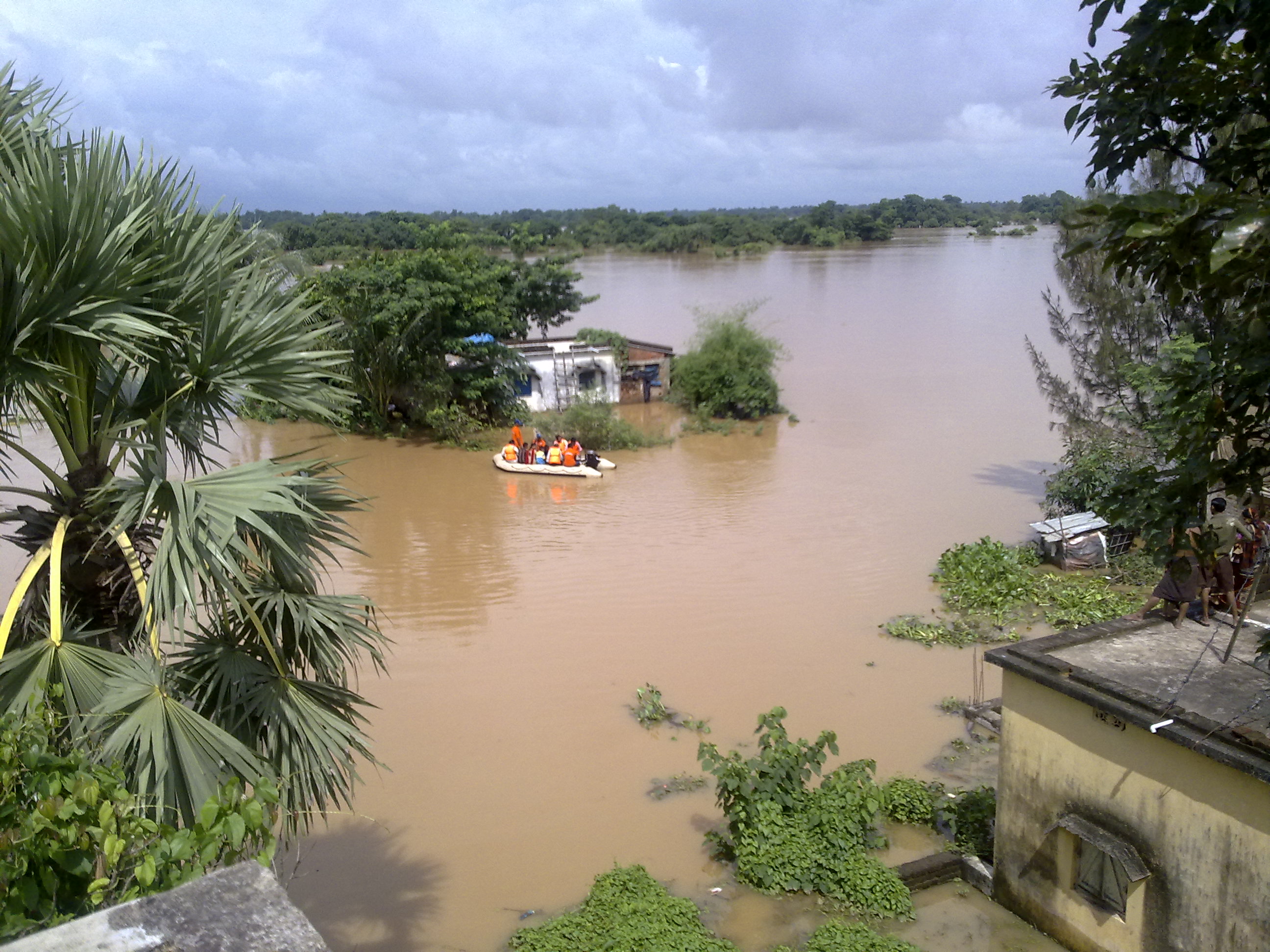
The rainfall from the summer monsoon can vary rapidly, and thus may result in drastic impacts to the region (see | The rainfall from the summer monsoon can vary rapidly, and thus may result in drastic impacts to the region (see Figure 2). Too much rainfall is known to cause devastating [[flood]]s, while too little negatively impacts agricultural output that these tropical countries depend on.<ref name=met/> Most of these regions do not have large irrigation systems or underground sources of [[water]] in [[aquifer]]s. Therefore they rely on this rainfall to fill their aquifers and provide water to their crops.<Ref name=natgeo/> | ||
==Winter monsoon== | ==Winter monsoon== | ||
| Line 21: | Line 21: | ||
The variance of monsoons are already quite drastic, and are only expected to fluctuate even more so as [[climate change]] effects become more prominent. Floods and droughts are of common occurrence in India and neighbouring regions. In 2002, India experienced 50% less rainfall than expected, resulting in reduced agricultural outputs and a decline in [[GDP]].<Ref name=met/> In contrast, in 2005 a strong monsoon devastated India with floods and killed over 1000 people.<ref name=natgeo/> | The variance of monsoons are already quite drastic, and are only expected to fluctuate even more so as [[climate change]] effects become more prominent. Floods and droughts are of common occurrence in India and neighbouring regions. In 2002, India experienced 50% less rainfall than expected, resulting in reduced agricultural outputs and a decline in [[GDP]].<Ref name=met/> In contrast, in 2005 a strong monsoon devastated India with floods and killed over 1000 people.<ref name=natgeo/> | ||
[[Global warming]] may already be increasing this variability, but models show that in the coming decades this variability will increase because of climate change. More moisture can be held in the [[atmosphere]] with higher [[temperature]]s, this will result in heavier rainfalls when they do occur.<ref name=met/> Simulations of future climate models over Southeastern Asia suggest increased average rainfalls, generally in the range of 5-10%. Such an increase could result in significant impacts to food production, financial stability, and civilian safety.<Ref name=met/> | [[Global warming]] may already be increasing this variability, but models show that in the coming decades this variability will increase because of climate change. More moisture can be held in the [[atmosphere]] with higher [[temperature]]s, this will result in heavier rainfalls when they do occur.<ref name=met/> Simulations of future [[Global climate model|climate models]] over Southeastern Asia suggest increased average rainfalls, generally in the range of 5-10%. Such an increase could result in significant impacts to food production, financial stability, and civilian safety.<Ref name=met/> | ||
The video below is a lecture from Prof. David Archer, Department of Geophysical Sciences at the University of Chicago,<ref name = Archer>Prof. David Archer has graciously allowed the use of this and other videos in a private communication with Jason Donev.</ref> talking about how clouds affect the Earth's climate: | The video below is a lecture from Prof. David Archer, Department of Geophysical Sciences at the University of Chicago,<ref name = Archer>Prof. David Archer has graciously allowed the use of this and other videos in a private communication with Jason Donev.</ref> talking about how clouds affect the Earth's climate: | ||
<HTML5video width="800" height="450" autoplay="false" loop="true">Monsoons_Archer</HTML5video> | <HTML5video width="800" height="450" autoplay="false" loop="true">Monsoons_Archer</HTML5video> | ||
== For Further Reading == | |||
* [[Prevailing winds]] | |||
* [[Precipitation]] | |||
* [[Cloud]] | |||
* [[Climate]] | |||
* Or explore a [[Special:Random|random page]] | |||
==References== | ==References== | ||
{{reflist}}[[Category:Uploaded]] | {{reflist}}[[Category:Uploaded]] | ||
Revision as of 23:15, 13 July 2026

A monsoon is a seasonal reversal in both the prevailing winds and associated precipitation over a region, caused by a difference in heating between a large land mass and the adjacent ocean.[2] Monsoon rains occur over tropical and subtropical regions, most commonly in areas near the Indian Ocean. Monsoons cause regions to experience intense wet and dry seasons, effectively driving these regions' climate.[3]
There are two primary monsoons, the well-known summer monsoon and the less powerful winter monsoon. These monsoons affect India (Figure 1) and Southeast Asia most dominantly, but also extend down to Australia and up to the Pacific coast of Russia. North America also experiences a yearly monsoon when moist air from the Gulf of California meets air from the Gulf of Mexico, which introduces uncommon rain into normally dry regions.[3]
Summer monsoon

Summer monsoons are associated with heavy rainfall.[3] As winter ends, warm winds from the southwestern Indian Ocean flow up towards Southern Asia bringing with it humid climate and intense rainfall. This hot air is caused by the intense radiant heat received from the Sun during its solar maximum in late spring which results in uneven heating of the Earth, and therefore increased winds.[5]
These regions rely on the rainfall produced by monsoons for various reasons. Most of these countries thrive agriculturally due to their location and the rain provides their crops with water. Also, a great deal of electricity in these regions is generated by use of hydroelectric facilities which rely on adequate rainfall to spin their turbines.[3]
The rainfall from the summer monsoon can vary rapidly, and thus may result in drastic impacts to the region (see Figure 2). Too much rainfall is known to cause devastating floods, while too little negatively impacts agricultural output that these tropical countries depend on.[5] Most of these regions do not have large irrigation systems or underground sources of water in aquifers. Therefore they rely on this rainfall to fill their aquifers and provide water to their crops.[3]
Winter monsoon
The lesser known winter monsoon isn't as impactful as the summer monsoon, partly due to the Himalaya Mountains preventing wind passage from the northeast. Winter monsoons typically bring the opposite climate of the summer monsoons, as they are often associated with droughts.[3]
Climate change effect on monsoons
The variance of monsoons are already quite drastic, and are only expected to fluctuate even more so as climate change effects become more prominent. Floods and droughts are of common occurrence in India and neighbouring regions. In 2002, India experienced 50% less rainfall than expected, resulting in reduced agricultural outputs and a decline in GDP.[5] In contrast, in 2005 a strong monsoon devastated India with floods and killed over 1000 people.[3]
Global warming may already be increasing this variability, but models show that in the coming decades this variability will increase because of climate change. More moisture can be held in the atmosphere with higher temperatures, this will result in heavier rainfalls when they do occur.[5] Simulations of future climate models over Southeastern Asia suggest increased average rainfalls, generally in the range of 5-10%. Such an increase could result in significant impacts to food production, financial stability, and civilian safety.[5]
The video below is a lecture from Prof. David Archer, Department of Geophysical Sciences at the University of Chicago,[6] talking about how clouds affect the Earth's climate:
For Further Reading
- Prevailing winds
- Precipitation
- Cloud
- Climate
- Or explore a random page
References
- ↑ Wikimedia Commons [Online], Available: https://upload.wikimedia.org/wikipedia/commons/9/9e/Ladakh_india_monsoon_clouds.jpg
- ↑ IPCC, 2012: Glossary of terms. In: Managing the Risks of Extreme Events and Disasters to Advance Climate Change Adaptation [Field, C.B., V. Barros, T.F. Stocker, D. Qin, D.J. Dokken, K.L. Ebi, M.D. Mastrandrea, K.J. Mach, G.-K. Plattner, S.K. Allen, M. Tignor, and P.M. Midgley (eds.)]. A Special Report of Working Groups I and II of the Intergovernmental Panel on Climate Change (IPCC). Cambridge University Press, Cambridge, UK, and New York, NY, USA, pp. 555-564.
- ↑ 3.0 3.1 3.2 3.3 3.4 3.5 3.6 National Geographic. (Accessed September 25, 2015). monsoon [Online], Available: http://education.nationalgeographic.com/encyclopedia/monsoon/
- ↑ Wikimedia Commons [Online], Available: https://upload.wikimedia.org/wikipedia/commons/6/6d/Floods.jpg
- ↑ 5.0 5.1 5.2 5.3 5.4 Royal Meteorological Society. (Accessed September 25, 2015). The Indian Monsoon in a Changing Climate [Online], Available: http://www.rmets.org/weather-and-climate/climate/indian-monsoon-changing-climate
- ↑ Prof. David Archer has graciously allowed the use of this and other videos in a private communication with Jason Donev.