
Coal bed methane: Difference between revisions
No edit summary |
m 1 revision imported |
||
| (2 intermediate revisions by 2 users not shown) | |||
| Line 1: | Line 1: | ||
[[Category:Done | [[Category:Done 2026-08-01]] | ||
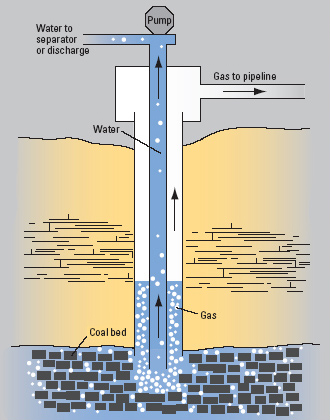
[[File:coalbed.png|400px|framed|right|Figure 1. The pumping process to remove coal bed methane.<ref>''Created internally by a member of the Energy Education team.'' Adapted from: https://d32ogoqmya1dw8.cloudfront.net/images/research_education/cretaceous/cbmrecovery.jpg</ref>]] | [[File:coalbed.png|400px|framed|right|Figure 1. The pumping process to remove coal bed methane.<ref>''Created internally by a member of the Energy Education team.'' Adapted from: https://d32ogoqmya1dw8.cloudfront.net/images/research_education/cretaceous/cbmrecovery.jpg</ref>]] | ||
<onlyinclude>''' | <onlyinclude>'''Coalbed methane''' is natural gas, composed primarily of [[methane]], that is trapped within underground [[coal seam]]s. Coalbed methane can be extracted using drilling techniques similar to those used for [[shale gas]].</onlyinclude> In these deposits, methane is adsorbed onto the surface of the [[coal]]. The coal seams are typically saturated with groundwater, which is pumped out to reduce pressure and allow the methane to flow from the seam. Pumping out the groundwater reduces [[pressure]] within the coal seam, allowing the methane to desorb from the coal and low toward the well.<ref name="RE1">G.Boyle, B.Everett, S.Peake, J.Ramage. (May 26, 2015). ''Energy Systems and Sustainability: Power for a Sustainable Future'', 2nd Ed. Oxford, UK: Oxford University Press, 2012.</ref> | ||
Coal bed methane is considered an [[ Conventional vs unconventional resource |unconventional gas]] | Coal bed methane is considered an [[ Conventional vs unconventional resource |unconventional natural gas]] resource because it occurs within coal seams rather than conventional gas [[oil and gas reservoir|reservoir]]s and requires specialized extraction techniques to produce economically.<ref name="RE3">Alberta Energy. (May 28, 2015). ''Coal Bed Methane'' [Online]. Available: http://www.energy.alberta.ca/naturalgas/754.asp</ref> | ||
Methane | Methane (CH<sub>4</sub>) is the primary component of natural gas,<ref name="RE2">J. Kraushaar, R. Ristinen. (May 28, 2015).Energy and the Environment, 2nd ed. Hoboken, NJ, U.S.A.: John Wiley & Sons, 2006, pp. 48</ref> so coalbed methane can be processed and used as [[Conventional vs unconventional resource|conventional]] natural gas. Although it is generally more difficult and costly to produce than conventional natural gas, coalbed methane has become an important source of natural gas in several regions of the world.<ref name="RE2"/> | ||
==Formation== | ==Formation== | ||
Coalbed methane forms as [[coal formation|coal is formed]]. As organic material dies and accumulates in swamps and other waterlogged environments, it undergoes bacterial and chemical changes that form [[peat]] deposits. Over millions of years, the peat becomes buried beneath many layers of sediment, causing its [[temperature]] and [[pressure]] to increase. Gradually, the peat transforms into [[lignite]] (brown coal), followed by [[sub-bituminous]] coal, [[bituminous]] coal, and finally [[anthracite]], the highest-rank coal.<ref name="RE3" /> As the coal is being forms, the decomposing organic material produces methane, the main component of natural gas, along with smaller amounts of [[carbon dioxide]] and [[nitrogen]]. As the coal is buried deeper beneath sediment, increasing pressure causes most of the methane to remain adsorbed onto the surface of the coal. | |||
==Extraction== | ==Extraction== | ||
Coalbed methane is considered to be an unconventional natural gas resource because it occurs within coal seams and requires specialized production techniques to produce it economically. The extraction of coalbed methane shares some similarities with shale gas production but also has important differences. First, a well is drilled into a [[coal seam]]. The well is then lined with steel casing that is cemented in place. Small holes, known as '''perforations,''' are created in the casing to allow methane and groundwater to flow into the wellbore for production.<ref name="RE3"/> Depending on the geology of the coal seam, wells may be drilled vertically, directionally, or [[horizontal well|horizontally]] to improve gas recovery. In some coal seams, [[hydraulic fracturing]] may be used to improve the flow of methane to the well, although many coalbed methane wells rely primarily on lowering water pressure within the seam to release the gas.<ref name="RE3"/> Some coal seams produce relatively little water and are referred to as '''dry coalbed methane wells.''' After coalbed methane gas has been produced, the coal seam remains and may be mined later, depending on economic, environmental, and regulatory considerations.<ref>Alberta Energy. (May 28, 2015). ''Coalbed Methane FAQ'' [Online]. Available: http://www.energy.alberta.ca/NaturalGas/750.asp</ref> | |||
==Environmental Concerns== | ==Environmental Concerns== | ||
One major | One major challenge in producing coalbed methane is the large volume of water that must often be removed from the coal seam before significant quantities of methane can be produced.<ref name="RE2"/> Protecting groundwater and surface water is a major environmental concern because the large volumes of produced water must be managed and disposed of safely. Produced water may be re-injected into underground rock formations, treated for beneficial use where feasible, or stored in evaporation ponds where permitted.<ref name="RE4">USGS. (May 28, 2015). ''Coal-Bed Methane: Potential and Concerns'' [Online]. Available: http://pubs.usgs.gov/fs/fs123-00/fs123-00.pdf</ref> In addition, some produced water, particularly from deeper wells, may contain high concentrations of dissolved salts and cannot be discharged without appropriate treatment. Instead, the water may require treatment to remove dissolved salts before it can be safely discharged or reused.<ref name="RE5">Alberta Energy. (May 28, 2015). ''Coalbed Methane Development'' [Online]. Available: http://www.energy.alberta.ca/NaturalGas/753.asp</ref> | ||
Another concern is the | Another environmental concern is the release of methane into the [[atmosphere]]. Atmospheric methane concentrations have increased over the past several decades, making methane emissions an important contributor to climate change.<ref name="RE4"/> Although producing coalbed methane can result in methane [[emission]]s, some argue that capturing methane before coal mining can reduce overall methane emissions by preventing the release of methane that would otherwise escape during mining operations.<ref name="RE4"/> | ||
'''Methane migration''' is another potential concern | '''Methane migration''' is another potential concern because, in some areas, methane has been detected in groundwater and, in rare cases, has migrated into residential areas. Some methane migration may occur naturally through existing fractures and faults, while other cases have been linked to problems with well construction, such as inadequate casing or cementing. Hydraulic fracturing has also been investigated as a possible contributing factor in some situations, although the evidence is less conclusive. Where wells are located near residential areas, methane migration can raise concerns about groundwater quality and, in some cases, the accumulation of methane in enclosed spaces.<ref name="RE4"/> | ||
== For Further Reading == | |||
* [[Coal seam]] | |||
* [[Conventional vs unconventional resource|Unconventional natural gas]] | |||
* [[Peat]] | |||
* [[Hydraulic fracturing]] | |||
* Or explore a [[Special:Random|random page]] | |||
==References== | ==References== | ||
{{reflist}} | {{reflist}} | ||
[[Category:Uploaded]] | [[Category:Uploaded]] | ||
Latest revision as of 20:43, 4 August 2026

Coalbed methane is natural gas, composed primarily of methane, that is trapped within underground coal seams. Coalbed methane can be extracted using drilling techniques similar to those used for shale gas. In these deposits, methane is adsorbed onto the surface of the coal. The coal seams are typically saturated with groundwater, which is pumped out to reduce pressure and allow the methane to flow from the seam. Pumping out the groundwater reduces pressure within the coal seam, allowing the methane to desorb from the coal and low toward the well.[2]
Coal bed methane is considered an unconventional natural gas resource because it occurs within coal seams rather than conventional gas reservoirs and requires specialized extraction techniques to produce economically.[3]
Methane (CH4) is the primary component of natural gas,[4] so coalbed methane can be processed and used as conventional natural gas. Although it is generally more difficult and costly to produce than conventional natural gas, coalbed methane has become an important source of natural gas in several regions of the world.[4]
Formation
Coalbed methane forms as coal is formed. As organic material dies and accumulates in swamps and other waterlogged environments, it undergoes bacterial and chemical changes that form peat deposits. Over millions of years, the peat becomes buried beneath many layers of sediment, causing its temperature and pressure to increase. Gradually, the peat transforms into lignite (brown coal), followed by sub-bituminous coal, bituminous coal, and finally anthracite, the highest-rank coal.[3] As the coal is being forms, the decomposing organic material produces methane, the main component of natural gas, along with smaller amounts of carbon dioxide and nitrogen. As the coal is buried deeper beneath sediment, increasing pressure causes most of the methane to remain adsorbed onto the surface of the coal.
Extraction
Coalbed methane is considered to be an unconventional natural gas resource because it occurs within coal seams and requires specialized production techniques to produce it economically. The extraction of coalbed methane shares some similarities with shale gas production but also has important differences. First, a well is drilled into a coal seam. The well is then lined with steel casing that is cemented in place. Small holes, known as perforations, are created in the casing to allow methane and groundwater to flow into the wellbore for production.[3] Depending on the geology of the coal seam, wells may be drilled vertically, directionally, or horizontally to improve gas recovery. In some coal seams, hydraulic fracturing may be used to improve the flow of methane to the well, although many coalbed methane wells rely primarily on lowering water pressure within the seam to release the gas.[3] Some coal seams produce relatively little water and are referred to as dry coalbed methane wells. After coalbed methane gas has been produced, the coal seam remains and may be mined later, depending on economic, environmental, and regulatory considerations.[5]
Environmental Concerns
One major challenge in producing coalbed methane is the large volume of water that must often be removed from the coal seam before significant quantities of methane can be produced.[4] Protecting groundwater and surface water is a major environmental concern because the large volumes of produced water must be managed and disposed of safely. Produced water may be re-injected into underground rock formations, treated for beneficial use where feasible, or stored in evaporation ponds where permitted.[6] In addition, some produced water, particularly from deeper wells, may contain high concentrations of dissolved salts and cannot be discharged without appropriate treatment. Instead, the water may require treatment to remove dissolved salts before it can be safely discharged or reused.[7]
Another environmental concern is the release of methane into the atmosphere. Atmospheric methane concentrations have increased over the past several decades, making methane emissions an important contributor to climate change.[6] Although producing coalbed methane can result in methane emissions, some argue that capturing methane before coal mining can reduce overall methane emissions by preventing the release of methane that would otherwise escape during mining operations.[6]
Methane migration is another potential concern because, in some areas, methane has been detected in groundwater and, in rare cases, has migrated into residential areas. Some methane migration may occur naturally through existing fractures and faults, while other cases have been linked to problems with well construction, such as inadequate casing or cementing. Hydraulic fracturing has also been investigated as a possible contributing factor in some situations, although the evidence is less conclusive. Where wells are located near residential areas, methane migration can raise concerns about groundwater quality and, in some cases, the accumulation of methane in enclosed spaces.[6]
For Further Reading
References
- ↑ Created internally by a member of the Energy Education team. Adapted from: https://d32ogoqmya1dw8.cloudfront.net/images/research_education/cretaceous/cbmrecovery.jpg
- ↑ G.Boyle, B.Everett, S.Peake, J.Ramage. (May 26, 2015). Energy Systems and Sustainability: Power for a Sustainable Future, 2nd Ed. Oxford, UK: Oxford University Press, 2012.
- ↑ 3.0 3.1 3.2 3.3 Alberta Energy. (May 28, 2015). Coal Bed Methane [Online]. Available: http://www.energy.alberta.ca/naturalgas/754.asp
- ↑ 4.0 4.1 4.2 J. Kraushaar, R. Ristinen. (May 28, 2015).Energy and the Environment, 2nd ed. Hoboken, NJ, U.S.A.: John Wiley & Sons, 2006, pp. 48
- ↑ Alberta Energy. (May 28, 2015). Coalbed Methane FAQ [Online]. Available: http://www.energy.alberta.ca/NaturalGas/750.asp
- ↑ 6.0 6.1 6.2 6.3 USGS. (May 28, 2015). Coal-Bed Methane: Potential and Concerns [Online]. Available: http://pubs.usgs.gov/fs/fs123-00/fs123-00.pdf
- ↑ Alberta Energy. (May 28, 2015). Coalbed Methane Development [Online]. Available: http://www.energy.alberta.ca/NaturalGas/753.asp