
Thermodynamics: Difference between revisions
J.williams (talk | contribs) m 1 revision imported |
Energy>Jmdonev No edit summary |
||
| Line 1: | Line 1: | ||
[[Category:Done 2026-06-01]] | |||
[[File:steamengine.jpg|300px|thumb|Figure 1. Steam-driven trains were one of the first products of thermodynamics.<ref>geograph UK [Online], Available: http://upload.wikimedia.org/wikipedia/commons/7/74/Sommerfeld1897.gif</ref>]] | [[File:steamengine.jpg|300px|thumb|Figure 1. Steam-driven trains were one of the first products of thermodynamics.<ref>geograph UK [Online], Available: http://upload.wikimedia.org/wikipedia/commons/7/74/Sommerfeld1897.gif</ref>]] | ||
<onlyinclude>'''Thermodynamics''' is the study of how [[heat]] can be transformed into useful [[energy]] in the form of [[work]], hence the name ''thermo'' + ''dynamics''.<ref name=Knight>Randall Knight, ''Physics for Scientists and Engineers,'' 3rd Ed. New York: Pearson, 2013, Ch. 16, p. 443.</ref> It is an extremely vast and intricate area of science which took many years to develop, beginning in the early 19th century.</onlyinclude> Scientists were beginning to understand the possibility of attaining work from a heat source, and this was first [[mechanical equivalent of heat|demonstrated by James Joule]] in the 1840's.<ref name=hist>Waterloo University, ''Historical Background'' [Online], Available: http://www.mhtl.uwaterloo.ca/courses/me354/past.html</ref> Thermodynamics gives the foundation for [[heat engine]]s, [[power plant]]s, [[chemical reaction]]s, [[refrigerator]]s, and many more important concepts that the world we live in today relies on. | <onlyinclude>'''Thermodynamics''' is the study of how [[heat]] can be transformed into useful [[energy]] in the form of [[work]], hence the name ''thermo'' + ''dynamics''.<ref name=Knight>Randall Knight, ''Physics for Scientists and Engineers,'' 3rd Ed. New York: Pearson, 2013, Ch. 16, p. 443.</ref> It is an extremely vast and intricate area of science which took many years to develop, beginning in the early 19th century.</onlyinclude> Scientists were beginning to understand the possibility of attaining work from a heat source, and this was first [[mechanical equivalent of heat|demonstrated by James Joule]] in the 1840's.<ref name=hist>Waterloo University, ''Historical Background'' [Online], Available: http://www.mhtl.uwaterloo.ca/courses/me354/past.html</ref> Thermodynamics gives the foundation for [[heat engine]]s, [[power plant]]s, [[chemical reaction]]s, [[refrigerator]]s, and many more important concepts that the world we live in today relies on. | ||
A full understanding of thermodynamics requires knowledge of how the microscopic world. Some key ideas that describe how the microscopic properties manifest at large scales include [[temperature]], [[pressure]] and [[internal energy]]. Understanding the properties of a system is crucial, but even more so is the transfer of this energy to other systems, known as [[heat transfer]]. An analysis of these ideas led scientists to the formulation of the four laws of thermodynamics.<ref name=hist/> | |||
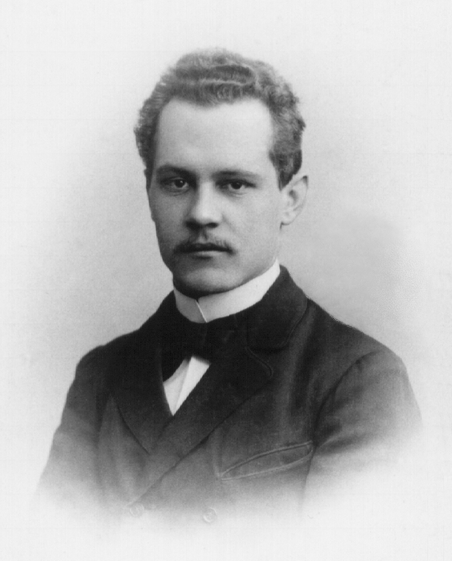
[[File:quotemeonthis.png|780px|center|thumb|<ref>Image of A. Sommerfeld via Wikimedia Commons [Online], Available: http://upload.wikimedia.org/wikipedia/commons/7/74/Sommerfeld1897.gif</ref>]] | [[File:quotemeonthis.png|780px|center|thumb|Figure 2. Quote by Arnold Sommerfeld.<ref>Image of A. Sommerfeld via Wikimedia Commons [Online], Available: http://upload.wikimedia.org/wikipedia/commons/7/74/Sommerfeld1897.gif</ref>]] | ||
==Laws of Thermodynamics== | ==Laws of Thermodynamics== | ||
The laws of thermodynamics lay the foundation for how a system can change, function, and supply useful energy. They are all fundamental statements to all of science, and introduce important concepts which extend far beyond the bounds of the topic. These statements are introduced below, and can be explored fully on their respective pages:<Ref>B. Everett, G. Boyle, S. Peake and J. Ramage, "Heat to motive power," in ''Energy Systems and Sustainability'', 2nd ed., Oxford, UK: Oxford, 2013, ch.6, pp.187</ref> | The laws of thermodynamics lay the foundation for how a system can change, function, and supply useful energy. They are all fundamental statements to all of science, and introduce important concepts which extend far beyond the bounds of the topic. These statements are introduced below, and can be explored fully on their respective pages:<Ref>B. Everett, G. Boyle, S. Peake and J. Ramage, "Heat to motive power," in ''Energy Systems and Sustainability'', 2nd ed., Oxford, UK: Oxford, 2013, ch.6, pp.187</ref> | ||
* '''[http://hyperphysics.phy-astr.gsu.edu/hbase/thermo/thereq.html#c2 | * '''The [http://hyperphysics.phy-astr.gsu.edu/hbase/thermo/thereq.html#c2 zeroth law of thermodynamics]''' - this law is a statement of [[thermal equilibrium]] and what that means for [[heat transfer]]. This is a way of thinking about what it means for two systems to be at the same temperature. | ||
* '''The [[first law of thermodynamics]]''' - this is essentially the [[law of conservation of energy]], but states that the change internal energy is given by an input of heat, work, or both. | * '''The [[first law of thermodynamics]]''' - this is essentially the [[law of conservation of energy]], but states that the change internal energy is given by an input of heat, work, or both. | ||
| Line 17: | Line 16: | ||
* '''The [[second law of thermodynamics]]''' - this law imposes more severe constraints on heat transfer and limits the [[thermal efficiency|efficiency]] of heat engines. It introduces the important idea of [[entropy]], which has some interesting implications. | * '''The [[second law of thermodynamics]]''' - this law imposes more severe constraints on heat transfer and limits the [[thermal efficiency|efficiency]] of heat engines. It introduces the important idea of [[entropy]], which has some interesting implications. | ||
*'''The [ | *'''The [[third law of thermodynamics]]''' (or view [https://chem.libretexts.org/Courses/University_of_Florida/CHM2047%3A_One-Semester_General_Chemistry_(Kleiman)/11%3A_Spontaneous_Processes_and_Thermodynamic_Equilibrium/11.06%3A_The_Third_Law_of_Thermodynamics here]) - the idea of [[absolute zero]] is introduced, and this law shows that nothing can be cooled to this temperature. | ||
==For Further Reading== | |||
*[[Heat engine]] | |||
*[[Power plant]] | |||
*[[Thermodynamic cycle]] | |||
*[[Fossil fuel]] | |||
*Or explore a [[Special:Random|random page]] | |||
==References== | ==References== | ||
{{reflist}} | {{reflist}} | ||
[[Category:Uploaded]] | [[Category:Uploaded]] | ||
Revision as of 22:40, 15 May 2026

Thermodynamics is the study of how heat can be transformed into useful energy in the form of work, hence the name thermo + dynamics.[2] It is an extremely vast and intricate area of science which took many years to develop, beginning in the early 19th century. Scientists were beginning to understand the possibility of attaining work from a heat source, and this was first demonstrated by James Joule in the 1840's.[3] Thermodynamics gives the foundation for heat engines, power plants, chemical reactions, refrigerators, and many more important concepts that the world we live in today relies on.
A full understanding of thermodynamics requires knowledge of how the microscopic world. Some key ideas that describe how the microscopic properties manifest at large scales include temperature, pressure and internal energy. Understanding the properties of a system is crucial, but even more so is the transfer of this energy to other systems, known as heat transfer. An analysis of these ideas led scientists to the formulation of the four laws of thermodynamics.[3]

Laws of Thermodynamics
The laws of thermodynamics lay the foundation for how a system can change, function, and supply useful energy. They are all fundamental statements to all of science, and introduce important concepts which extend far beyond the bounds of the topic. These statements are introduced below, and can be explored fully on their respective pages:[5]
- The zeroth law of thermodynamics - this law is a statement of thermal equilibrium and what that means for heat transfer. This is a way of thinking about what it means for two systems to be at the same temperature.
- The first law of thermodynamics - this is essentially the law of conservation of energy, but states that the change internal energy is given by an input of heat, work, or both.
- The second law of thermodynamics - this law imposes more severe constraints on heat transfer and limits the efficiency of heat engines. It introduces the important idea of entropy, which has some interesting implications.
- The third law of thermodynamics (or view here) - the idea of absolute zero is introduced, and this law shows that nothing can be cooled to this temperature.
For Further Reading
- Heat engine
- Power plant
- Thermodynamic cycle
- Fossil fuel
- Or explore a random page
References
- ↑ geograph UK [Online], Available: http://upload.wikimedia.org/wikipedia/commons/7/74/Sommerfeld1897.gif
- ↑ Randall Knight, Physics for Scientists and Engineers, 3rd Ed. New York: Pearson, 2013, Ch. 16, p. 443.
- ↑ 3.0 3.1 Waterloo University, Historical Background [Online], Available: http://www.mhtl.uwaterloo.ca/courses/me354/past.html
- ↑ Image of A. Sommerfeld via Wikimedia Commons [Online], Available: http://upload.wikimedia.org/wikipedia/commons/7/74/Sommerfeld1897.gif
- ↑ B. Everett, G. Boyle, S. Peake and J. Ramage, "Heat to motive power," in Energy Systems and Sustainability, 2nd ed., Oxford, UK: Oxford, 2013, ch.6, pp.187